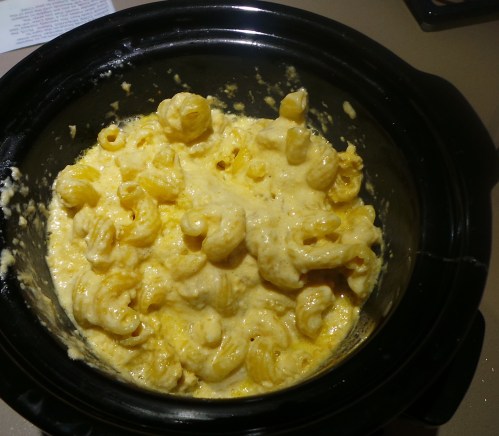
Low-Fuss Macaroni and Cheese (Slow Cooker)

I think I mentioned some time ago that I lived in Texas for a bit and that, when I was there, I cooked mostly with a little 1.5 litre (1 Quart) slow cooker.

Many wonderful things emerged from that device (and were eaten with gusto), but one that I still continue to make is Mac and Cheese.

Now, during my residency of San Antonio, I discovered that Americans have a plethora of magazines devoted to slow cookers and slow cooking – it was quite startling just how many there were when I’ve yet to see one such thing here in Oz. No doubt we will soon catch up given that Diabetes specific magazines are appearing here now too and they had oodles of those.

Remember the Alamo.

Remember the Alamo.

Anyway, I bought one or two and was off. It was in one of them that I discovered that Macaroni and Cheese could be prepared all-in-one-pot and cooked slow. Unfortunately, I didn’t bring my copies of the magazines back with me (excess luggage dontchaknow) so I can’t attribute this with an original source. However, I have fiddled with it and made it often enough now that I can honestly say that I don’t think it actually resembles the original all that closely.

The original held something called Velveeta – which didn’t agree with me at all, and several cheeses containing the word “Jack” in their names. This is another American phenomenon that has yet to reach our supermarkets (along with the orange food colouring in cheeses!)

So, here is my low fuss version of Mac and Cheese à la Slow Cooker. The recipe I will give you to print at the bottom of the post will contain specific instructions for making it in a 5 litre slow cooker and will make enough to serve a very hungry family. Probably with leftovers.

The photographs, however, will be of my current (Australian-wired) 1.5 litre slow cooker being used to make a smaller amount. The process is the same, as are the results, but the two of us do NOT need several weeks worth of leftovers!

Also, what you see will not have been measured precisely. I tend to do this using the patent-pending Sharon’s Handfuls method of measuring, other wise known as a handful of this and a handful of that.

Let us begin.

To the bottom of your crock add your uncooked pasta. This may be elbows, it may be spirals or it may even be tiny tubes – think macaroni rather than spaghetti and you’ll be fine.
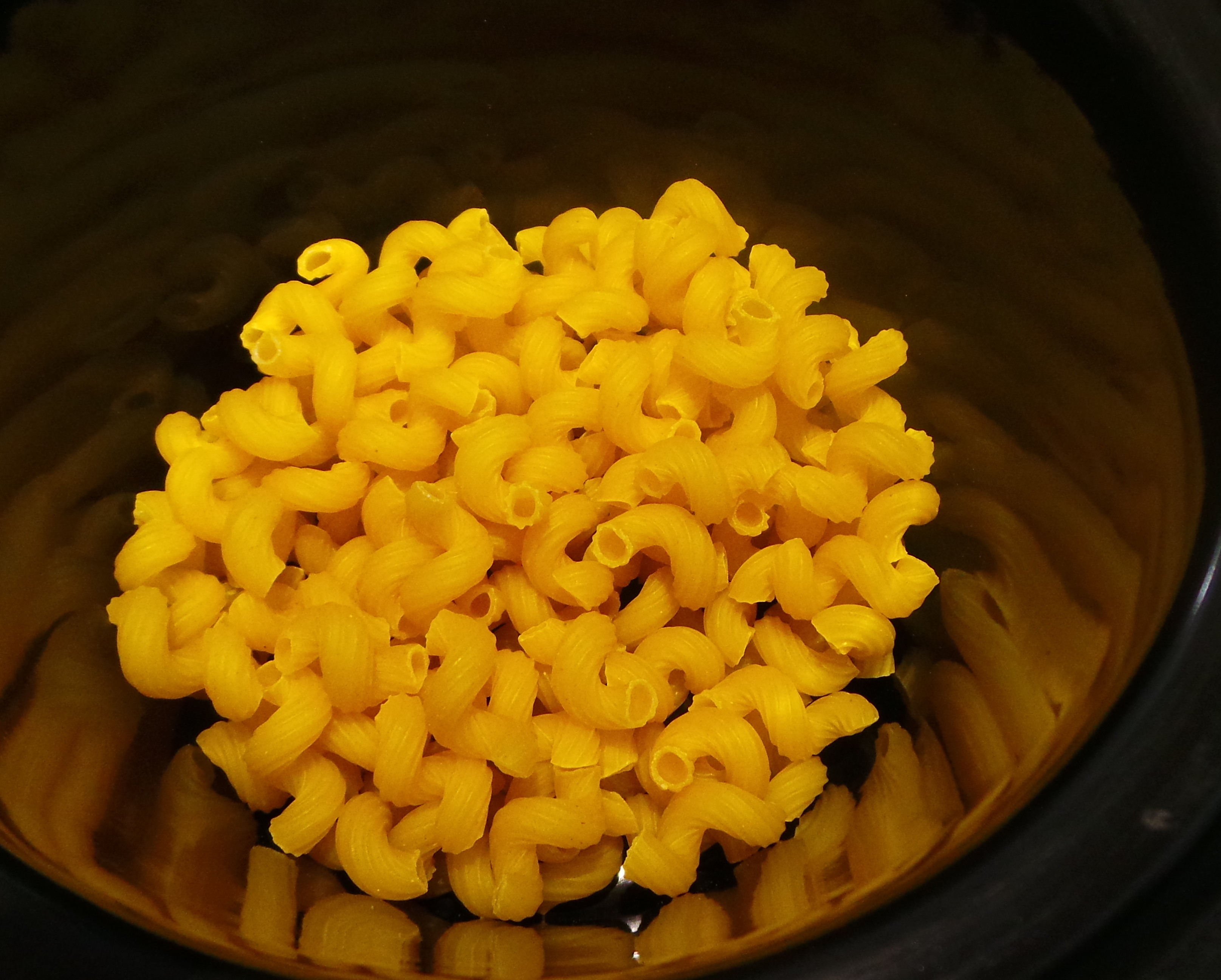
Place your uncooked macaroni in the crock

Place your uncooked macaroni in the crock

Next, add your cheese. This may be one type of cheese or a mix of several. This is a dish that lends itself well to using up the odds and ends of cheeses that may be lurking in the corners of your refrigerator. In the past I have used mixes including cheddar, fetta, parmesan, edam, gouda, brie, camembert, mozzarella and once I included a smidgen of a blue cheese. (Which doesn’t mean that I used all of these at once!)

I would limit your choice of cheese to one strong-tasting one among other milder flavours or you may find yourself with something that smells too confusing to eat.

You have been warned.

Plain old cheddar works fine, so don’t panic if that’s all you’ve got. The recipe calls for grated and cubed, I had pre-shredded cheeses in my fridge so that’s what I used – along with a good twist or two of black pepper and a sprinkling of paprika.
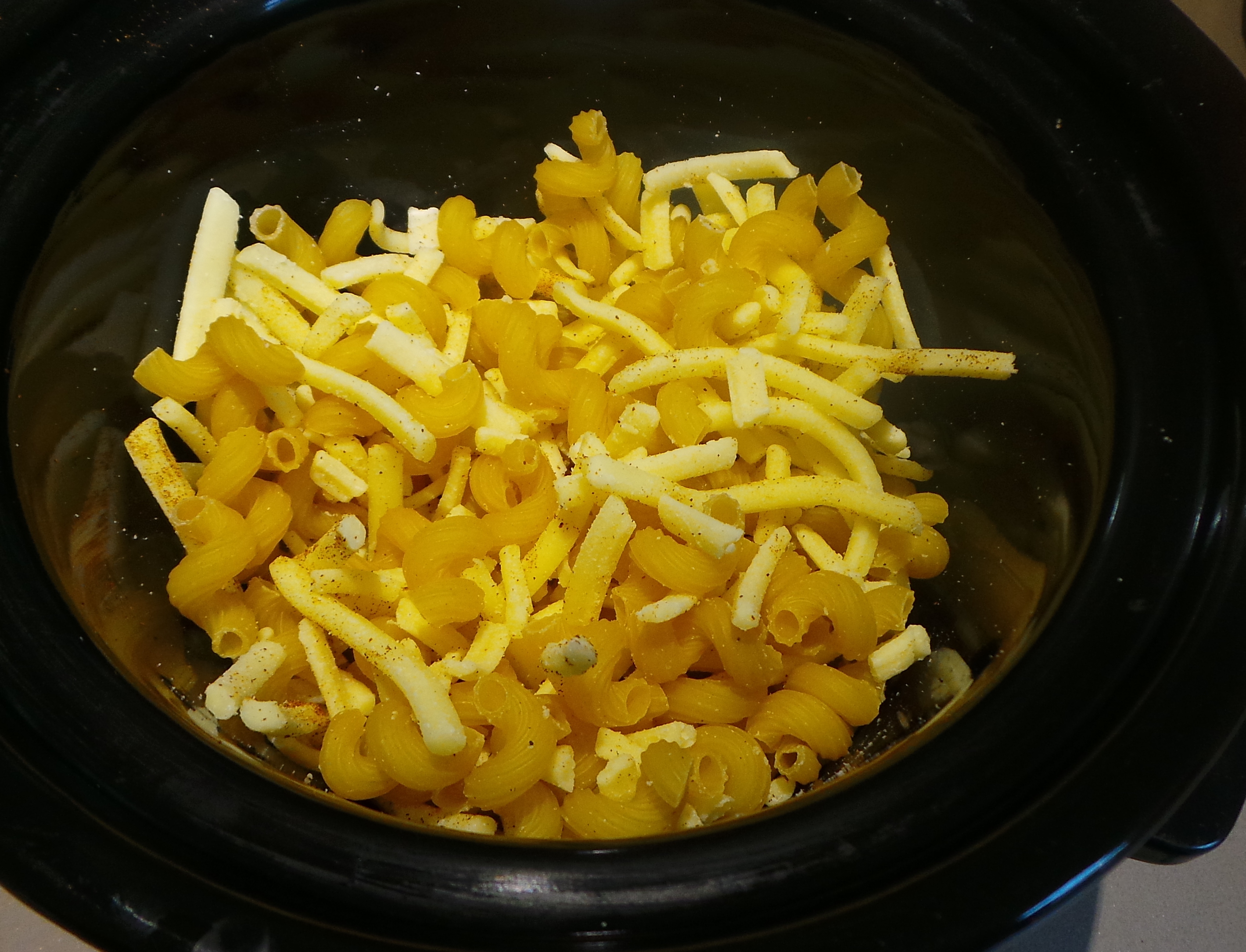
Add your cheese and seasonings

Add your cheese and seasonings.

Now, cover your mixture with milk. This may be cow’s milk, goat’s milk, soy milk, almond milk – get my drift? Pasta cooks in liquid and it doesn’t much care what that liquid is. In my baby slow cooker I tend to use a tin of evaporated milk and then add enough of whatever milk is in the refrigerator to cover the pasta.

That’s the important bit. You want your pasta to be completely submerged.
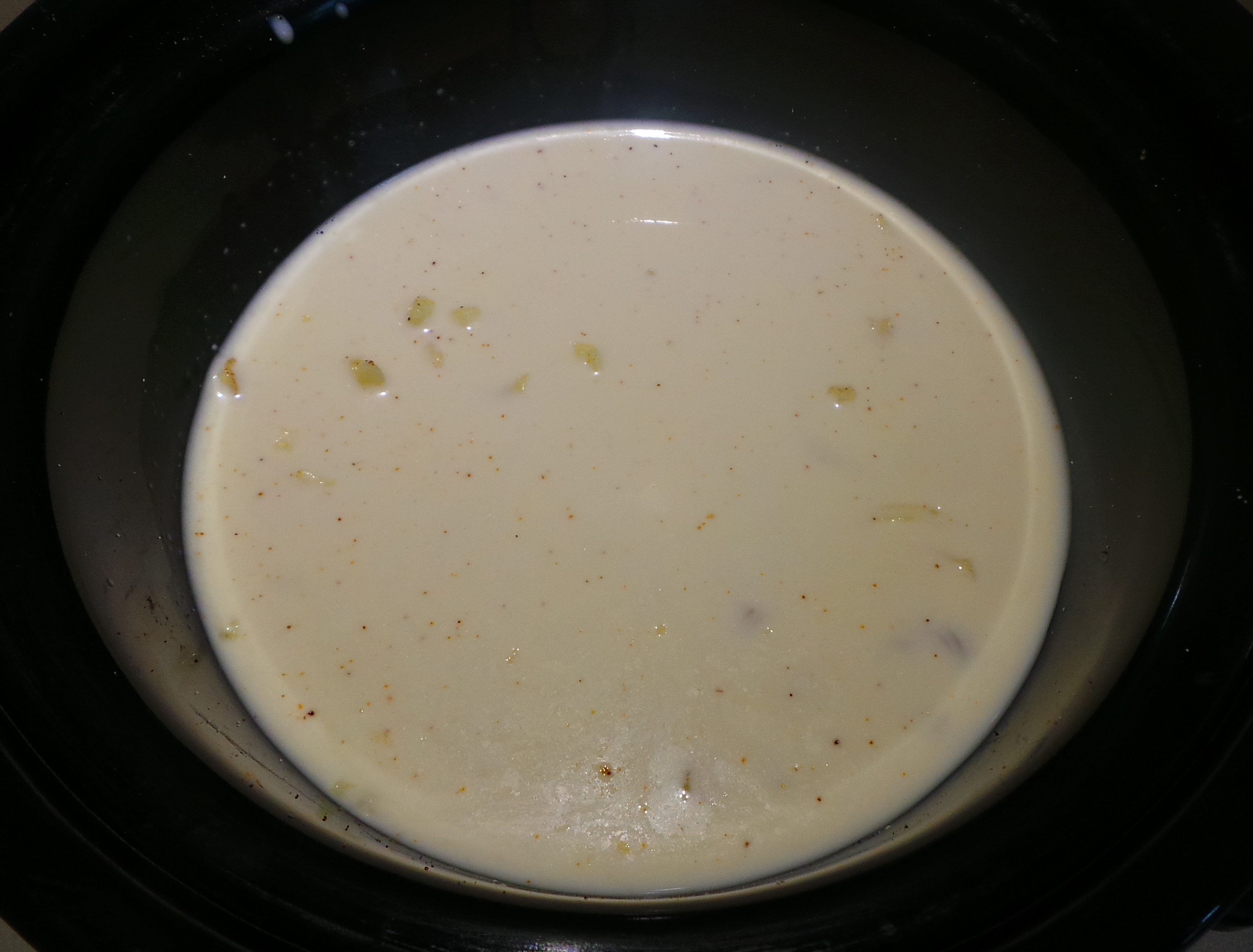
Cover with milk.

Cover with milk.

Now cover it and cook it on low for 2 to 3 hours. It doesn’t take that long in a tiny slow cooker, so keep an eye on it.

After 30 mins or so, you’ll notice your cheeses melting.
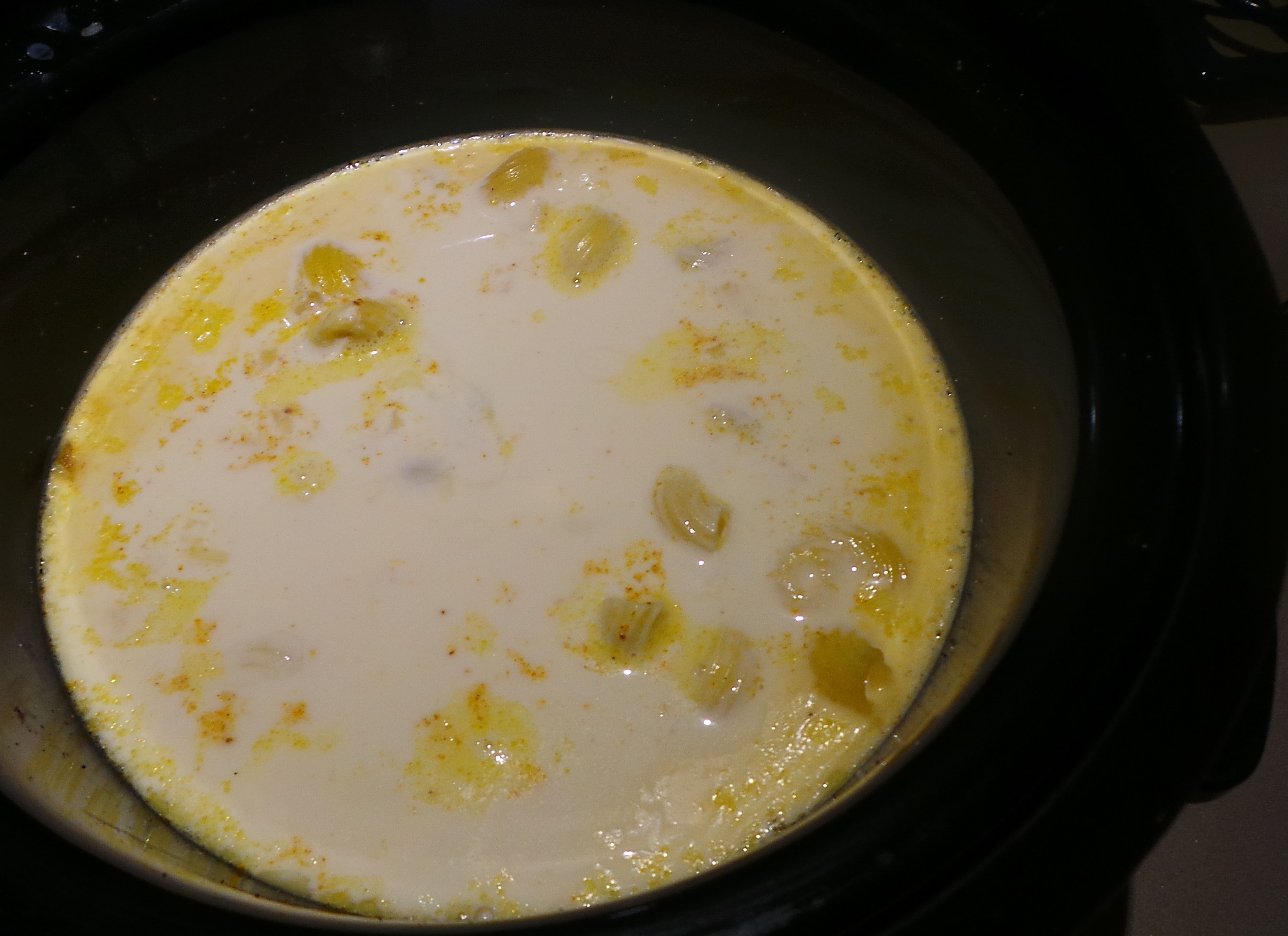
Melting cheeses...

Melting cheeses…

This is good and eminently desirable. Keep up the good work. If you feel the need to stir, then do so. This dish is quite forgiving and will let you remove the lid once or twice without slowing things down immensely.

When your pasta is cooked to your liking, serve it up.

All done.

I, however, like to fiddle. I also am very much of the meal-in-a-bowl school of catering. So I always add stuff to my mac and cheese.

This is not mandatory.

If you have them, frozen peas can add a change of texture as well as a burst of both flavour and colour – as can frozen corn. The heat of the dish will thaw them so there is no need to cook separately first. Use whatever vegetables you have to hand.

Asparagus has just come into season here, so I cut two stalks up and stirred them through my pot. Asparagus is best cooked lightly and here it steamed in the heat of the pasta.

asparagus

A stalk or two of asparagus adds a touch of colour and a burst of flavour.

I also had two lonely continental frankfurters sitting in my fridge and – as they, too, just need reheating and not cooking – sliced them up and popped them in.

Some sliced frankfurters

Some sliced frankfurters

I prefer to use fewer of these more expensive frankfurters, instead of more of a cheaper hot dog, as I like the taste and texture better. The flavour is head and shoulders above that of a hot dog and the filling doesn’t have that ‘mushy’ texture you often get in hot dogs. It’s one of those cases where it is absolutely worth spending more to buy less – but you’ll be so much more satisfied with the finished dish.

Feel free to use whatever you have to hand to add flavour and nutrition to your dish. For a vegetarian option, try adding half a tin of drained chickpeas.

Anyway, mixed through and plated up, our meal looked like this, and it was glorious. Given that it was put together at the last minute on what had turned into a very cold and gloomy day, it was ‘perfick’.

Slow cooker mac and cheese with extra added flavour and colour.

Slow cooker mac and cheese with extra added flavour and colour.

This is very filling. Trust me. Serving sizes do not need to be large.

Should there be any left in your slow cooker after plating your meals, then remove it immediately into a storage container for refrigeration. Then fill your crock with hot water and a squirt of dishwashing liquid before you sit down to eat. The slight delay will save you a world of frustration.

If you let the macaroni cool in the pot, it will set solid as melted cheese tends to do. This makes it a little more difficult to divide into … lunch containers for work the next day, just say…

Also, cheese can be difficult to clean off pots. By soaking it you will be getting a head start on the washing up and making the process a lot easier when you get to it.

Low Fuss Macaroni and Cheese (Slow Cooker)

  • Servings: 6-8
  • Difficulty: easy
  • Print

Ingredients:

2 cups (250 g) uncooked elbow macaroni

250 g light cheddar cheese, cubed

250 g tasty cheddar cheese, grated

500ml milk

salt and pepper to taste

Method:

In a 5 litre slow cooker, combine macaroni, cheeses and seasoning.

Cover with the milk.

Put the lid on the pot and cook on LOW for 2 to 3 hours, stirring after 20 minutes.



Hidden Treasure Muffins

Allow to cool completely before storing in an air-tight container.

So, you’ve made yourself some Dulce de Leche, or even some Lemon Curd – now what?

Make these.

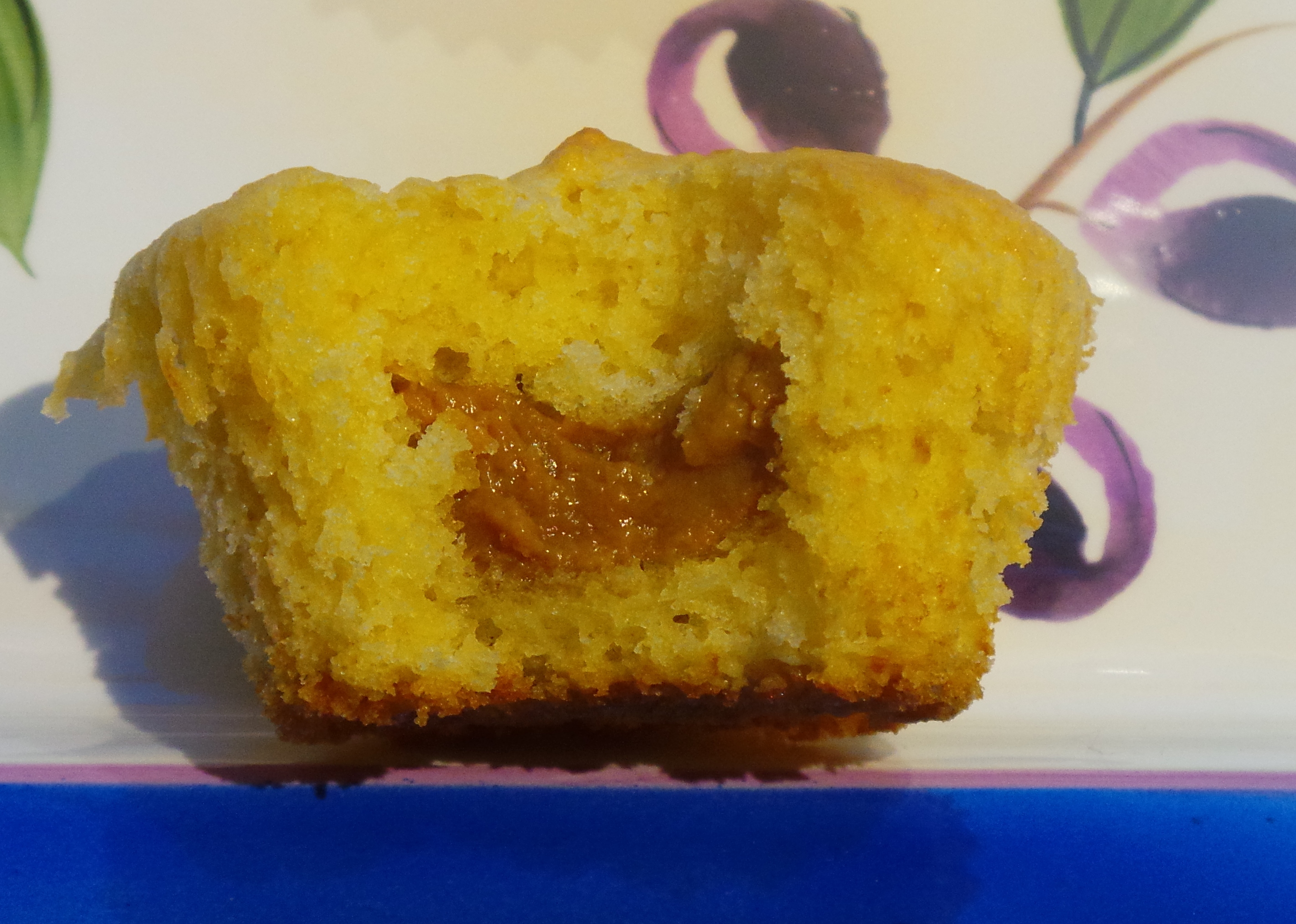
Simple, tasty, made from things you’re likely to have already and hiding a sweet(er) surprise, what’s not to love about these morsels?

You now you want one.

You know you want one.

A batch or two of muffins mixed up on a Sunday afternoon and stored in an air-tight container can provide you with a week’s worth of school/work lunch treats. That can save you quite a bit of money over the medium to longer term, especially if you provide your own beverage as well.

They taste better than most mass-produced cakes (there’s a certain floury taste to things made from a premix) and you get to look mysterious when people beg you to tell them where you bought them…

Get picky. Eat only the best, and that usually means things made from scratch – it doesn’t mean things that are too difficult to make yourself. I promise.

These particular muffins make use of things you’ve already learned how to make here: dulce de leche and/or lemon curd.

Before I start to guide you through it, though, just a quiet word. Muffins are sensitive souls. They need a gentle touch – one that will let them know they are loved and then leave them alone…

In other words, don’t overmix them!

As soon as all the flour is incorporated, stop. Just stop. That is all.

Treat them gently, and you too could have a platter that looks like this.

A veritable treasure trove.

A veritable treasure trove.

If you do happen to overmix them, it simply means your muffins won’t rise as much and will be slightly denser in texture.

This is not a tragedy.

This is a reason to try again and see if you can improve your results.

Shall we begin?

Preheat your oven to Moderately Hot.

Start by sifting your Self Raising flour and baking soda together into a large mixing bowl.

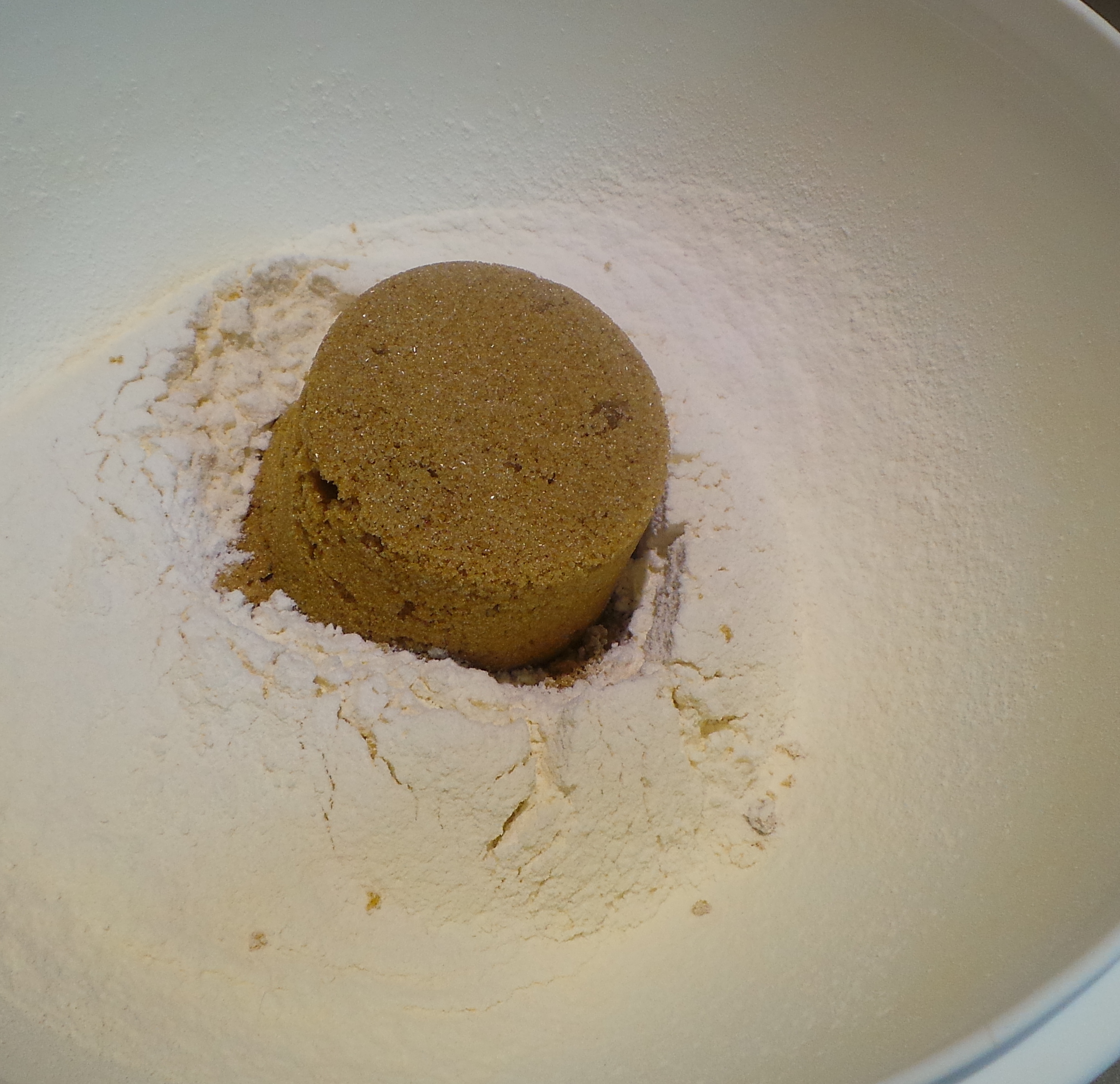
Add your brown sugar, but be careful to pack it into your measuring cup first! When you tip it into the mixing bowl it will look like those sand castles you used to make with your bucket at the beach.

This is a brown sugar sandcastle.

This is a brown sugar sandcastle.

Mash it up with your spatula or wooden spoon to get rid of lumps and stir into the flour.

How are you doing so far?

Believe it or not — you’re nearly done!

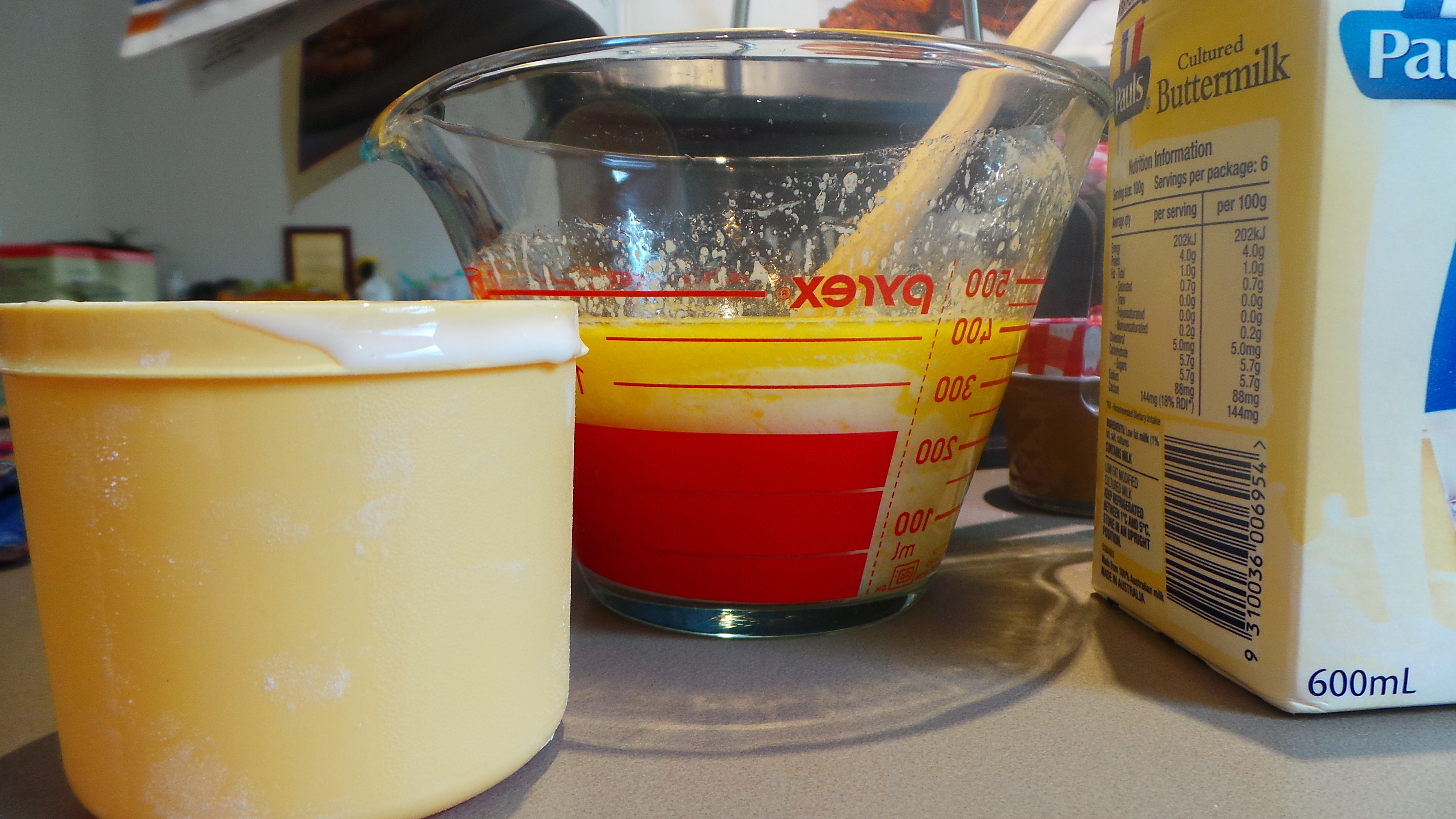
Melt your butter. This can be done in a small saucepan over a low heat on the stove, or in a microwave.

I use a pyrex jug for mine and zap it at 50% for a minute and then repeat until it’s liquid. Then I stir the buttermilk into the milk.

Mix your butter and buttermilk together.

Mix your butter and buttermilk together.

If you can’t find buttermilk anywhere, then a 50/50 mix of plain yoghurt and milk will also work; alternatively add a tablespoon of lemon juice or white vinegar to a cup of milk and wait 5 minutes.
Break your egg into your butter mixture and whisk well with a fork.

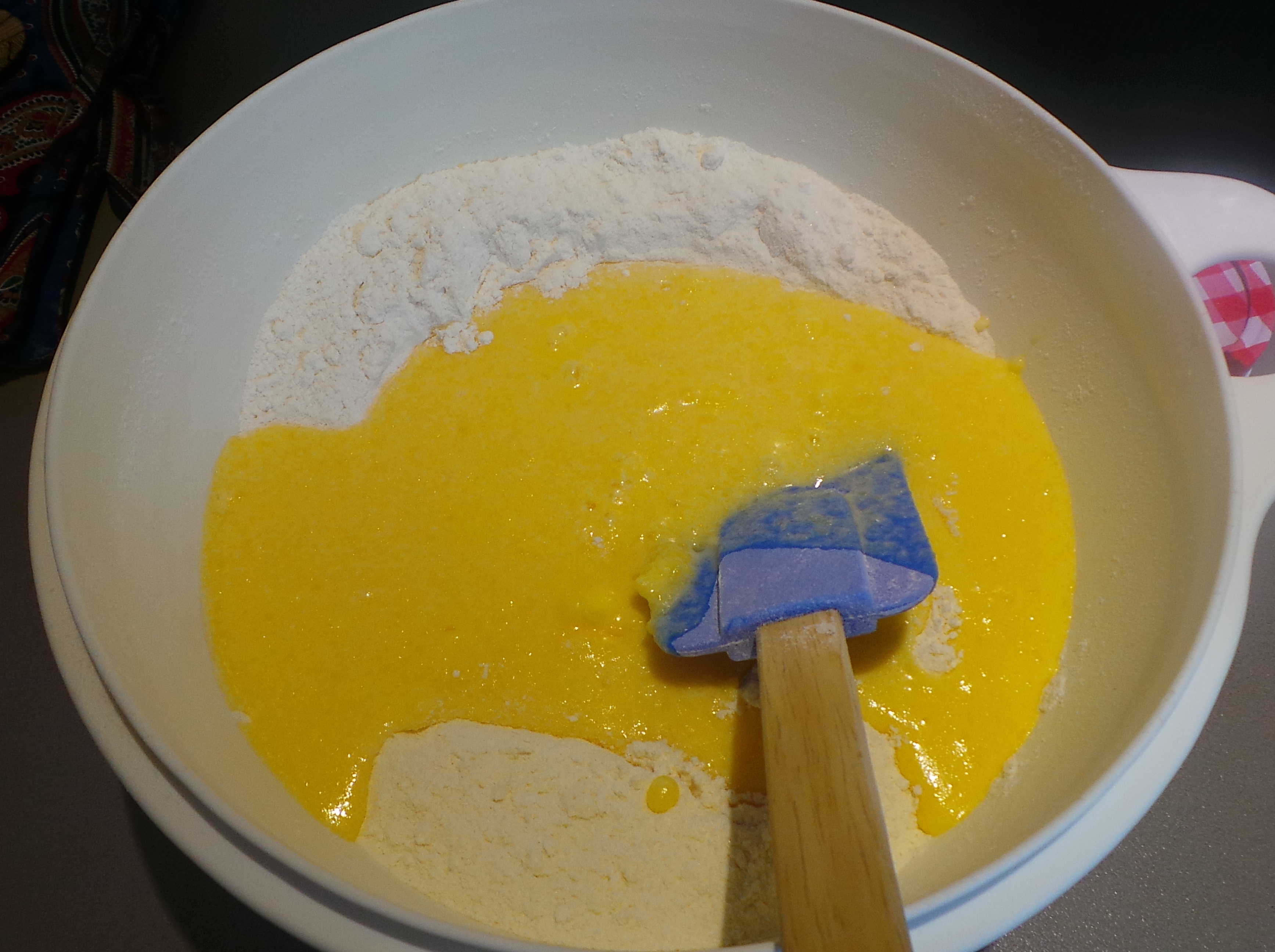
Then make the ever-necessary well in your flour and pour the liquid into it.

Add the wet to the dry

Add the wet to the dry

Then stir – quickly and gently. Try stirring around the outside and then slicing underneath. It’s hard to describe and I think I may need to post a video at some stage.

In the meantime…just don’t beat the life out of it.

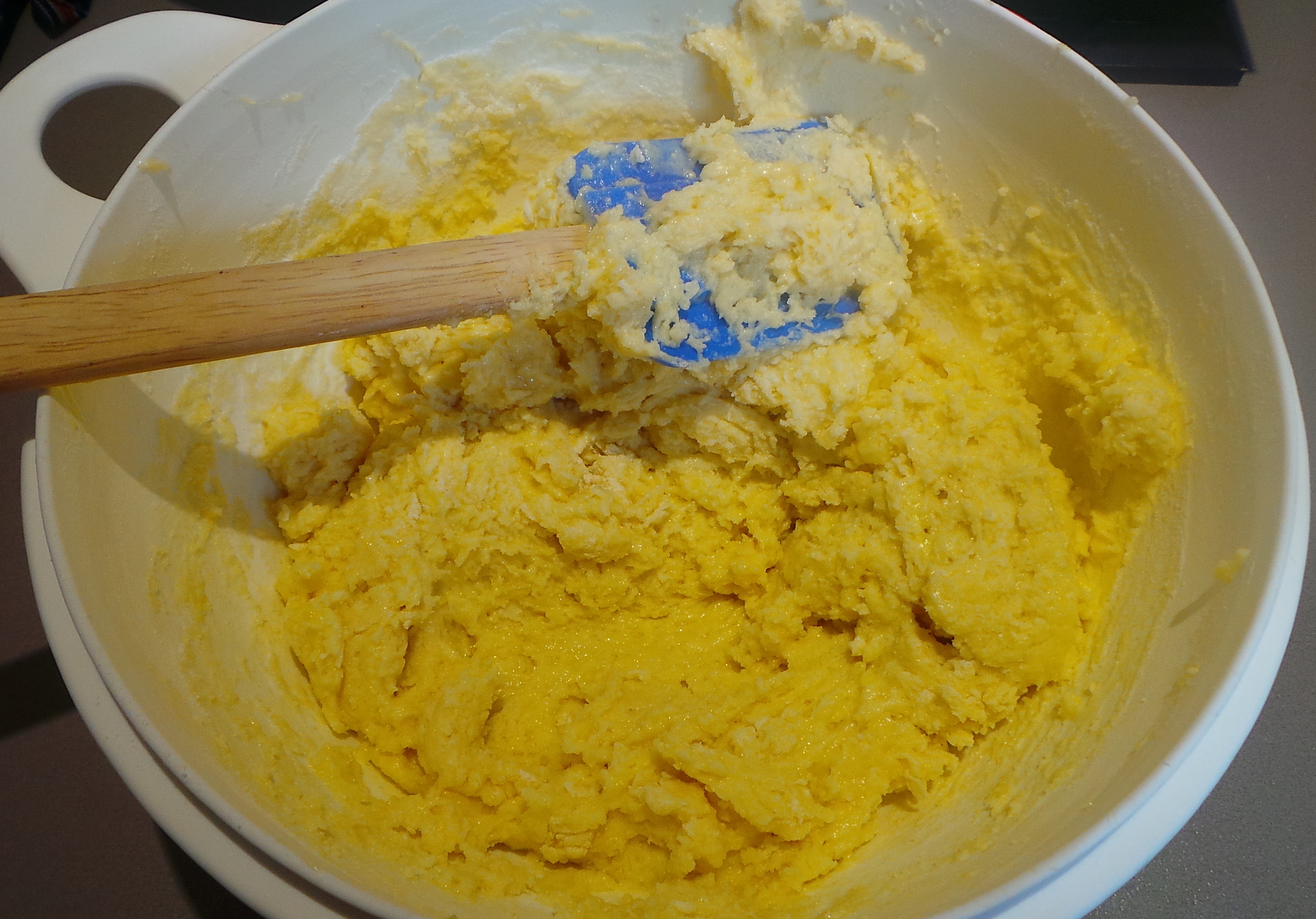
When all the ingredients are just combined. Stop. This is not a cake batter, it will not be smooth and liquid. It will look lumpy – like this.

Stop when it is just mixed together.

Stop when it is just mixed together.

Place some muffin cases into your muffin tray. You could just grease the cups, but the paper cases make eating your snacks a much cleaner experience, means they don’t stick together when stored and also make it easier to pack them for lunches.

If you don’t own a muffin tray (I’ve had mine for nearly 20 years, add it to your list.) then use a flat baking sheet or pizza tray and place double thickness muffin cases on top and close together. You could even do this in a cake tin, if you wished.

Dollop spoonfuls of the mix into the bottom of your muffin cups. Don’t spread or smooth the batter, just leave it as it falls.

Fill the bottom of your muffin cups.

Fill the bottom of your muffin cups.

Now for the fun bit. Deploy your fillings. I used a teaspoonful of dulce de leche per muffin in this example. It’s quite sweet and I thought that would be sufficient. You may use more, of course!

I would use a tablespoon of Lemon Curd for this purpose, but it’s still up to you (and how much you have to hand!)

It helps to fill a coffee cup with boiling water and dip your metal spoon into it before dipping it into your cold filling. The heat will cut through the cold caramel and help it to slip nicely off into the cups. There is no need to dry your spoon between dunkings.

Use a cup of hot water to help spoon out your filling.

Use a cup of hot water to help spoon out your filling.

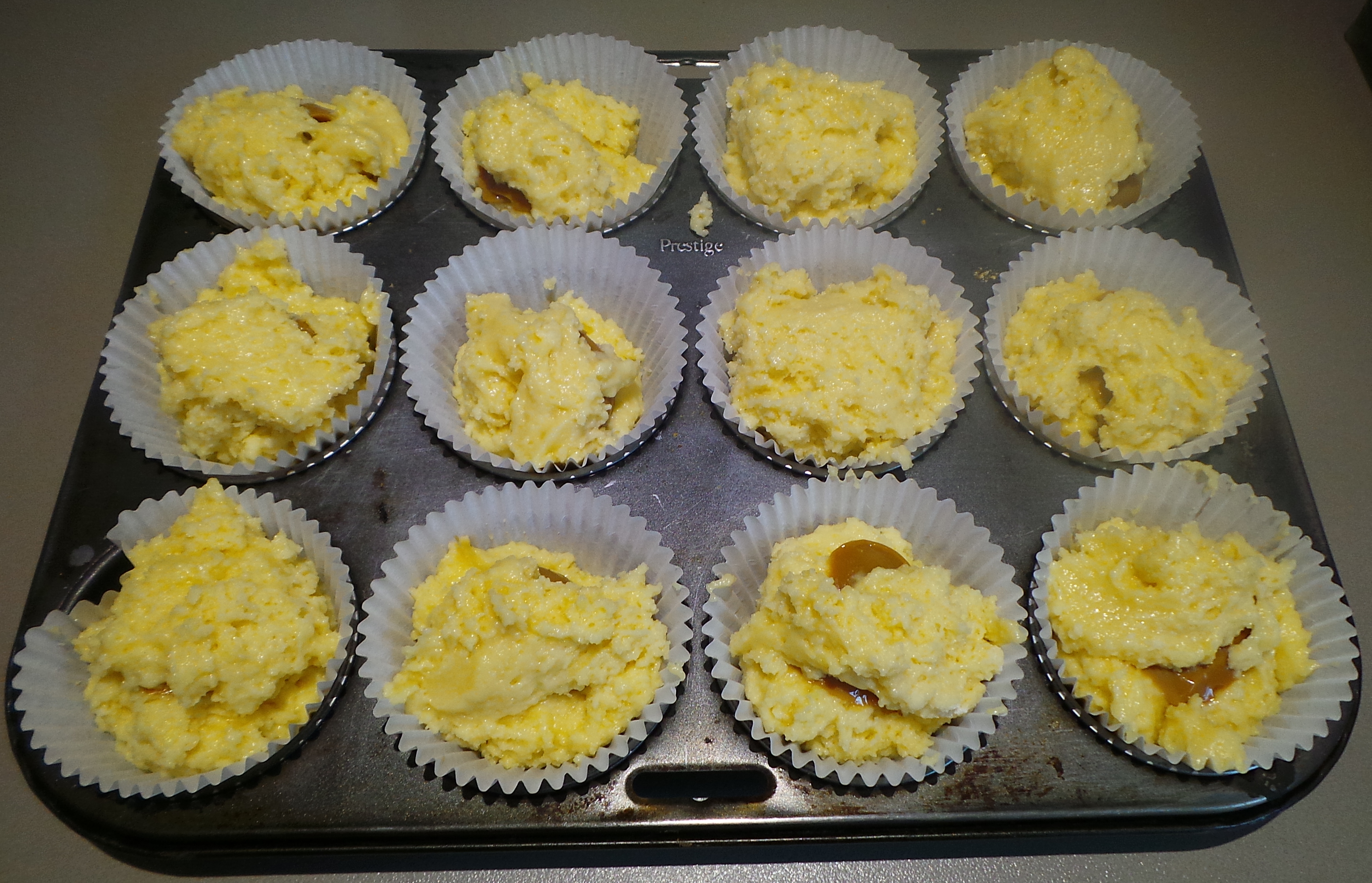
Now cover your caramel with the rest of the muffin mix.

Hide the treasure.

Hide the treasure.

Pop into your hot oven to bake for 20 mins, while you wash up ;-).

If your oven is not fan-forced, you may wish to rotate the tray at the half-way point to ensure even browning.

When done, test by inserting a toothpick or skewer into the center of the thickest muffin. If it comes out clean of raw batter, it’s cooked. Just remember you may hit caramel or lemon curd too!

Allow to cool in the tray for 10-20 mins and then move to a cake rack to cool completely. Set up a guard if you wish to keep them for lunches during the week to come…

Allow to cool completely before storing in an air-tight container.

Allow to cool completely before storing in an air-tight container.

Chocolate-Hazelnut Muffins: If you tire of using your Dulce de Leche or Lemon Butter in these, and the budget permits, then try sifting a ¼cup of cocoa in with your flour and using a cup of Nutella to fill with.

You’re welcome.


Hidden Treasure Muffins

  • Servings: 12
  • Print

Ingredients:

2½ cups self raising flour

½ tsp bicarbonate of soda (Baking Soda)

½ cup brown sugar, firmly packed

125g butter, melted

2 eggs, lightly beaten

1 cup (250 ml) buttermilk

2/3 cup Dulce de Leche or Lemon Curd

Method:

Grease a 12 hole muffin pan, or line with paper cases. (I find this makes transporting them a lot easier.)

Heat your oven to Moderately Hot – 200°C or 400°F.

Sift flour and bicarb into a large bowl.

Add brown sugar and break up any lumps as you stir them together.

In a pyrex measuring jug (for ease) heat your butter in a microwave for 1 minute at 50% power. Repeat until melted. (This step can be done in a small saucepan over low heat if a microwave is not available.)

Add butter milk to jug and whisk together, then add eggs. Mix liquid thoroughly.

Make a well in your flour and pour in all the liquid at once.

Fold together until just mixed. DO NOT BEAT!

Cover the bottom of your muffin cups with a tablespoon or so of the batter.

Place a spoonful or so (it is up to you how generous you wish to be…) of your caramel or lemon curd on to this and then top with the rest of the batter.

Bake on the top shelf of your oven for 20 mins, rotating the tray halfway through.

Test for doneness by inserting a toothpick or skewer through the thickest part of a muffin. If it comes out clean of batter, it’s done.

Leave to cool in the muffin tray for 20 mins or so, before removing to a cake rack to cool completely.

Store in an airtight container.

Enjoy!


Slow cooker beef with Asian flavours (from scratch)

Asian-flavoured slow-cooked beef

Okay, so some of you may have clicked over from here. You may find some repetition in this post, so bear with me. Please?

This little concoction is my answer to the “I don’t know what to cook, but I’ll probably be hungry later —and tired—, so this will do” situation.

I’m sure you know what I mean.

Asian-flavoured slow-cooked beef

Asian-flavoured slow-cooked beef

This is something I can get into the slow cooker in minutes and serve a few hours later – filling my home with gorgeous smells in the intervening period.

I own several slow cookers but the one I use the most has got to be my smallest one. It’s a 1.5 litre or 1 quart sized appliance and it’s perfect for meals for two. All the photos in this post have been taken with this device.

Feel free to double or triple what I do here and then cook it in a larger slow-cooker. It will take longer than the few hours a small one would use to cook the smaller portion, but not much longer.

Start with half a kilo or a pound of chuck steak and cut into large cubes.

Cut into large cubes.

Cut into large cubes.

Add your spices to the meat on the cutting board. You can measure them carefully if you wish, I just tend to give each a good shake until I think the meat looks covered enough. I’ve had readers *demand* I give an actual measurement though, so start with a teaspoon of each and then decide if future versions need more or less. It’s completely up to you.

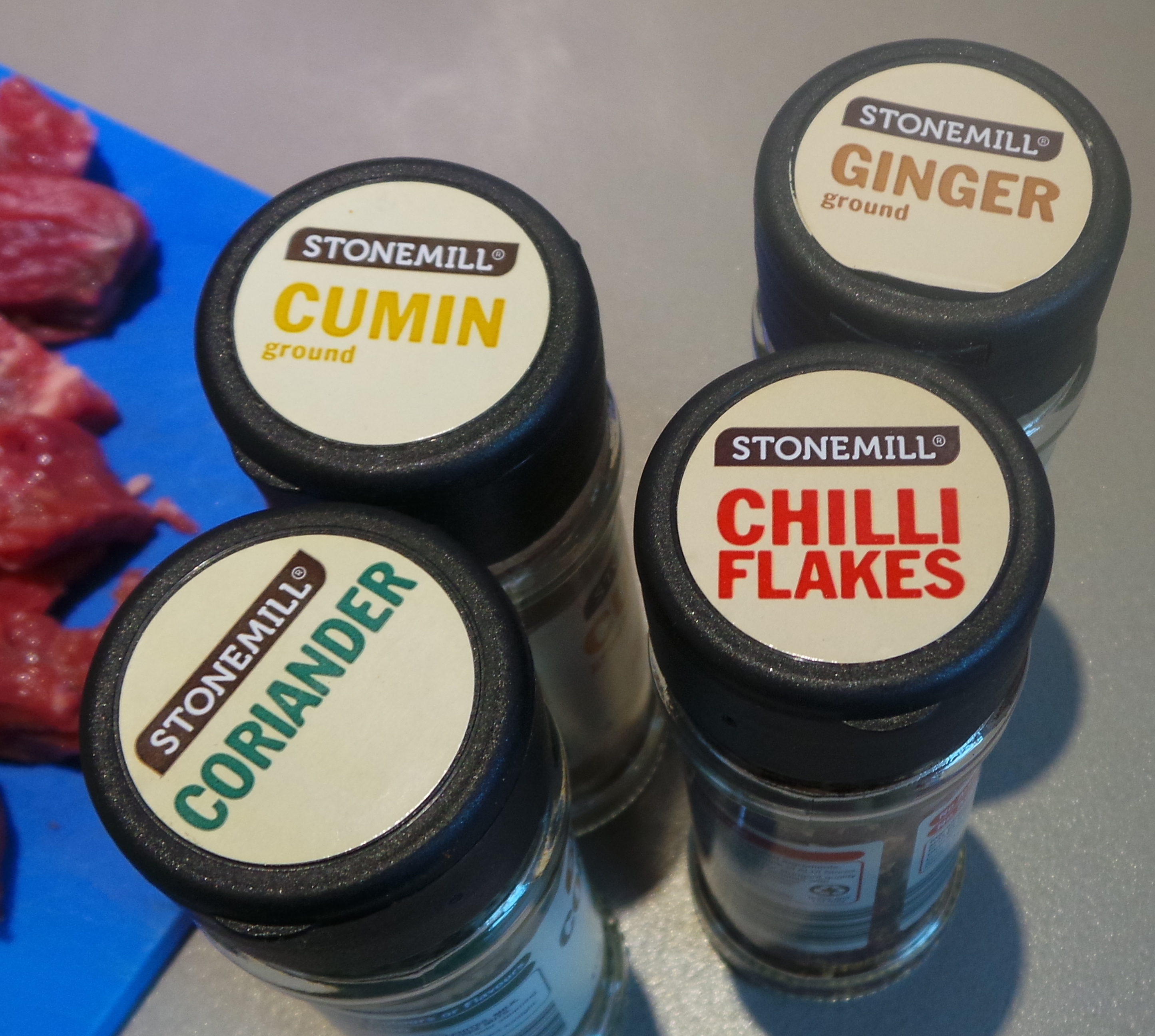
I used these spices:

This is a nice blend of flavours

This is a nice blend of flavours

I find ground cumin, ground coriander and ground ginger combine really well as an accompaniment to beef. It’s a combination that you’ll find often on these pages, but that doesn’t mean you have to use them. If you don’t like ginger, leave it out, it’s your meal after all.

On the other hand, if you are new to this cooking lark, give it a shot and see how you go. You never know, it may win you over.

I add a smattering of chilli flakes just to add a little heat without taking over the dish. I find it easier to control how much I dispense by shaking when I use flakes, chilli powder can be disastrous …

Spice your meat

Spice your meat

Now, I prepare some vegetables for the pot. It’s a very simple, very traditional combination of an onion, a carrot and a little celery.

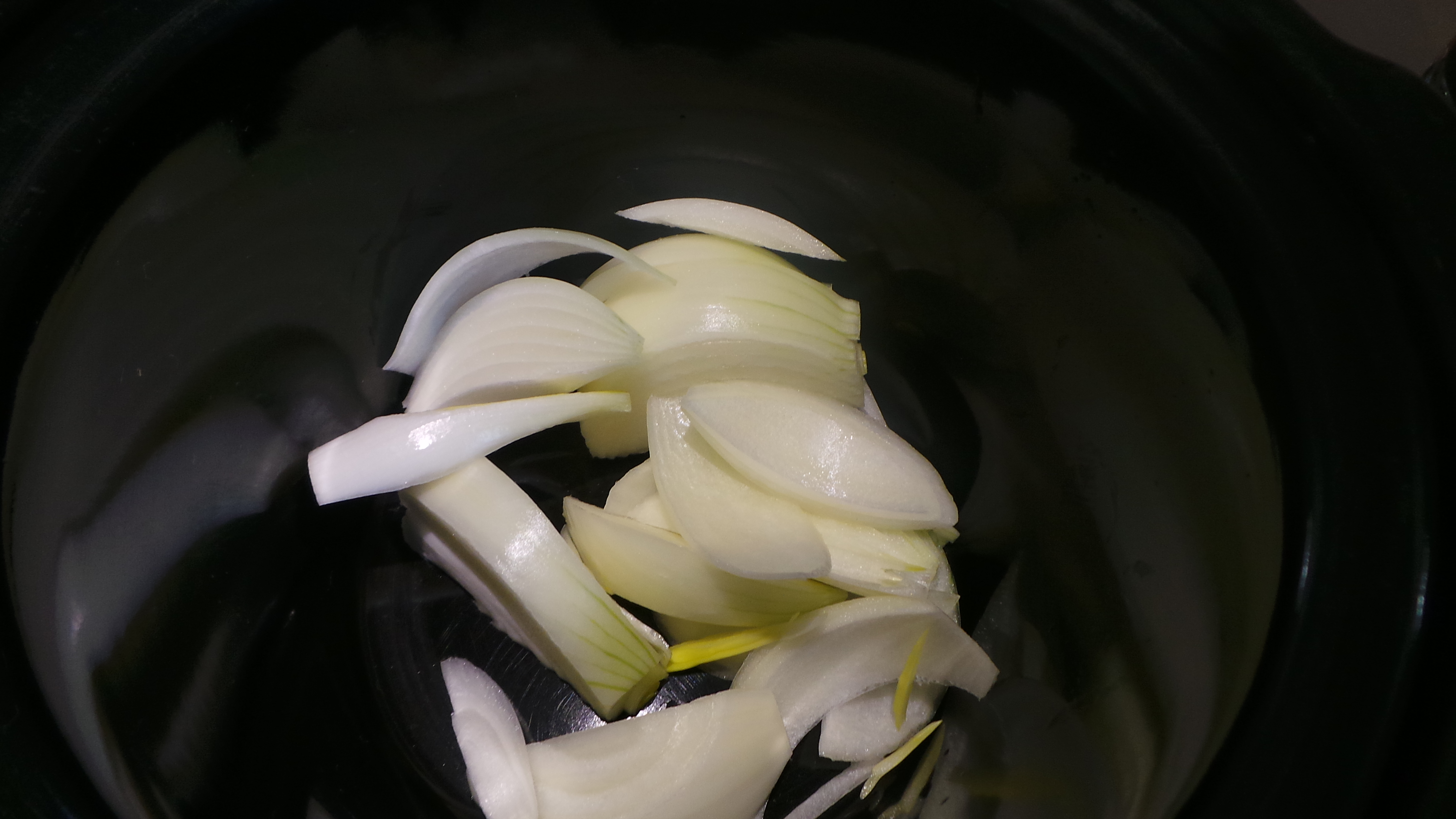
Cut your onion into crescents.

Little crescent moons of onions

Little crescent moons of onions

Add to the base of the slow cooker.

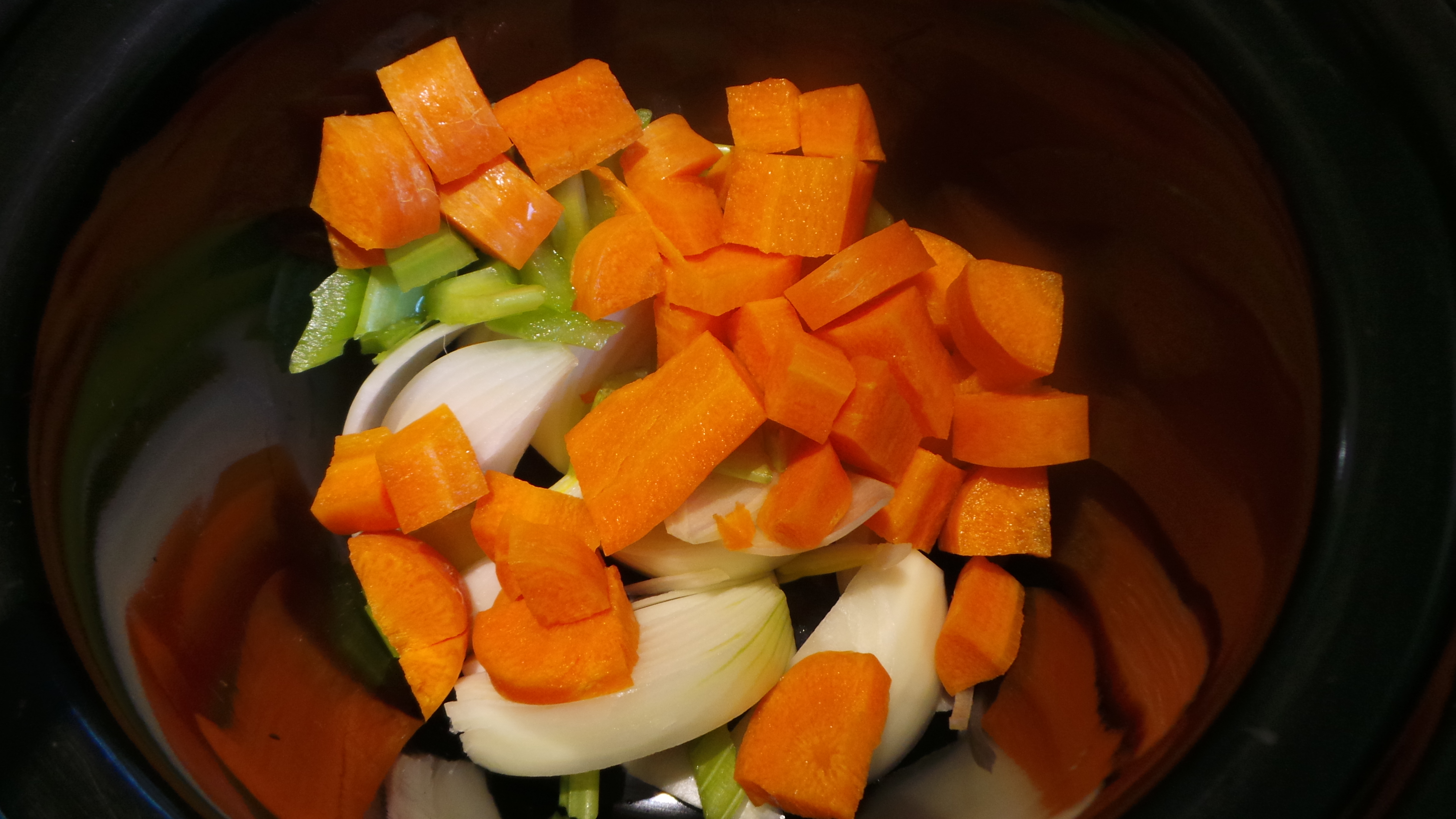
Dice your carrots and celery and add them as well.

Add carrots and celery.

Add carrots and celery.

Again, you can use whatever combination you like. However, I find that these are three that I always have to hand and they form a very good base for most main meal dishes. It’s a mix that is often referred to as the ‘Holy Trinity’ of cooking, so let’s just go with the flow…

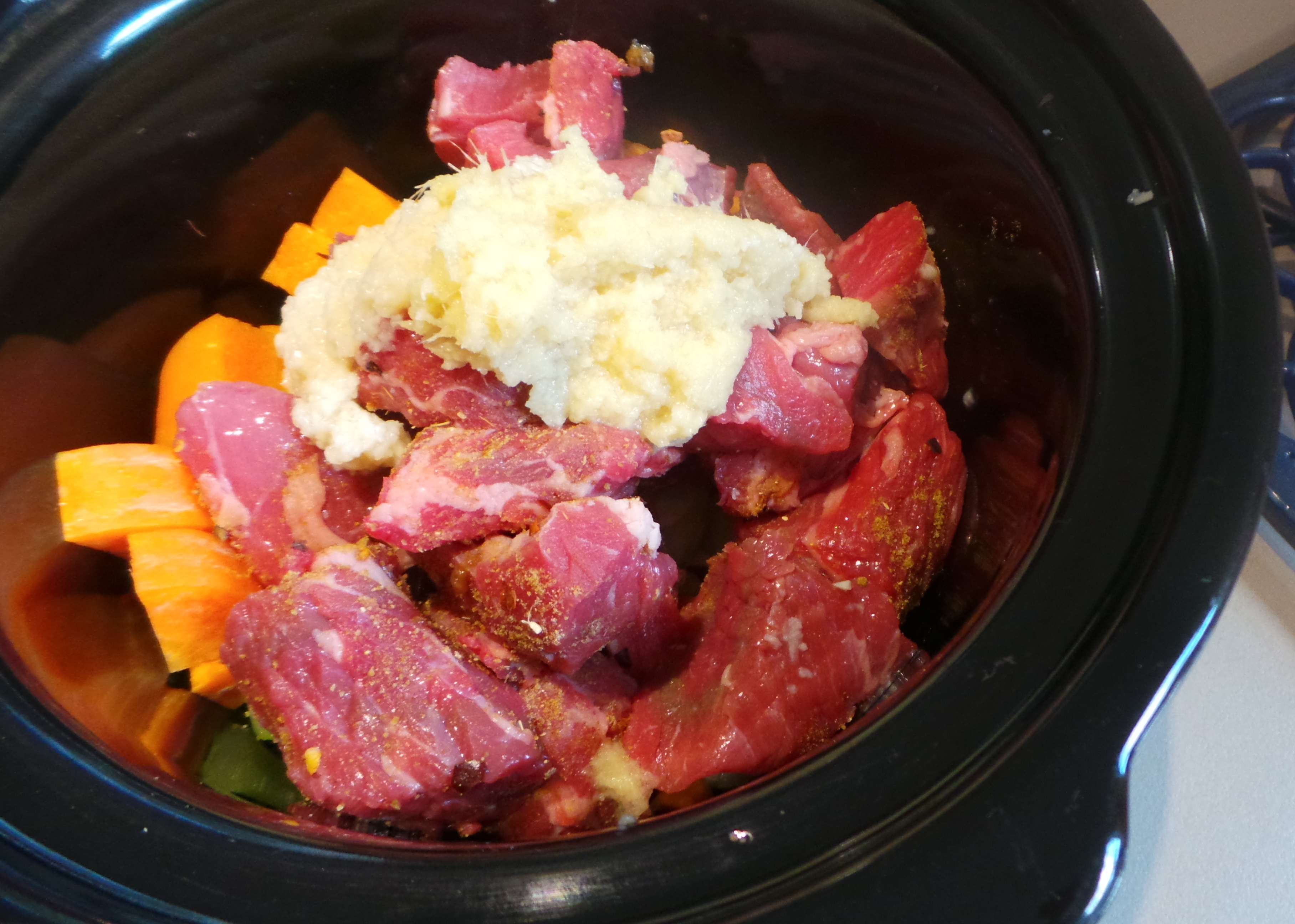
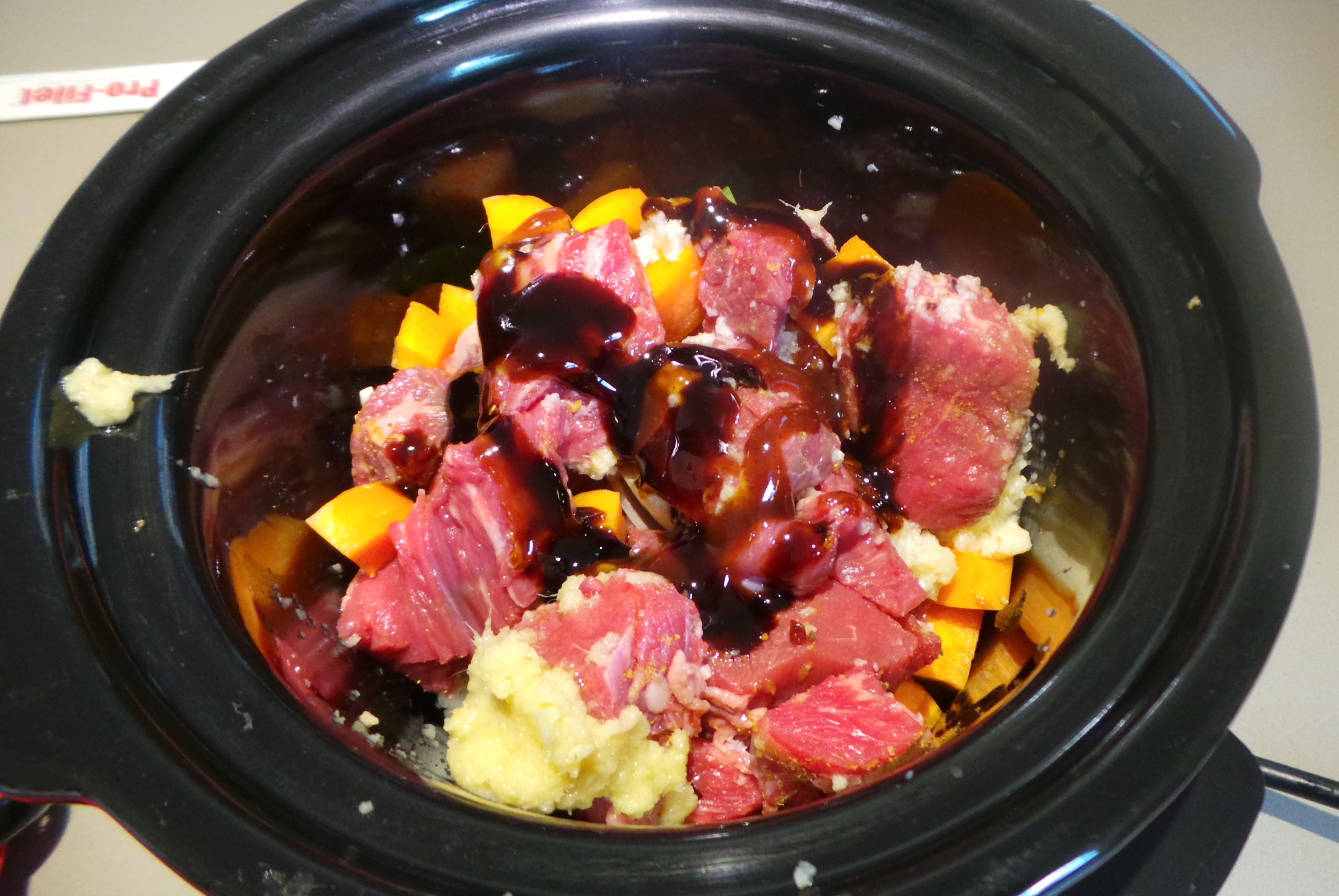
Now place your spiced meat into the pot, on top of the vegetables. Don’t stir yet!

I always keep these guys in my refrigerator, add a good teaspoonful of each to the pot.

Refrigerator staples.

Refrigerator staples.

Up the flavour with some fresh ginger and garlic.

Up the flavour with some fresh ginger and garlic.

Now add a good glug of the sauces you’d like to use.  On this occasion, I had these in my refrigerator door: Soy & Honey sauce, Hoi Sin and some sesame oil.

*A ‘glug’ may be translated as a tablespoon or so. You’re just adding flavours, not creating a cooking medium.

Choose your sauces

Choose your sauces

Add some glugs to the pot

Add a few glugs of whatever sauces you wish to the pot.

You may wish to use plain soy sauce, black bean, teriyaki, sweet chilli, oyster sauce, kecap manis…the list goes on. You don’t have to use a mix, you may use just one if you prefer (or if that is all you have).

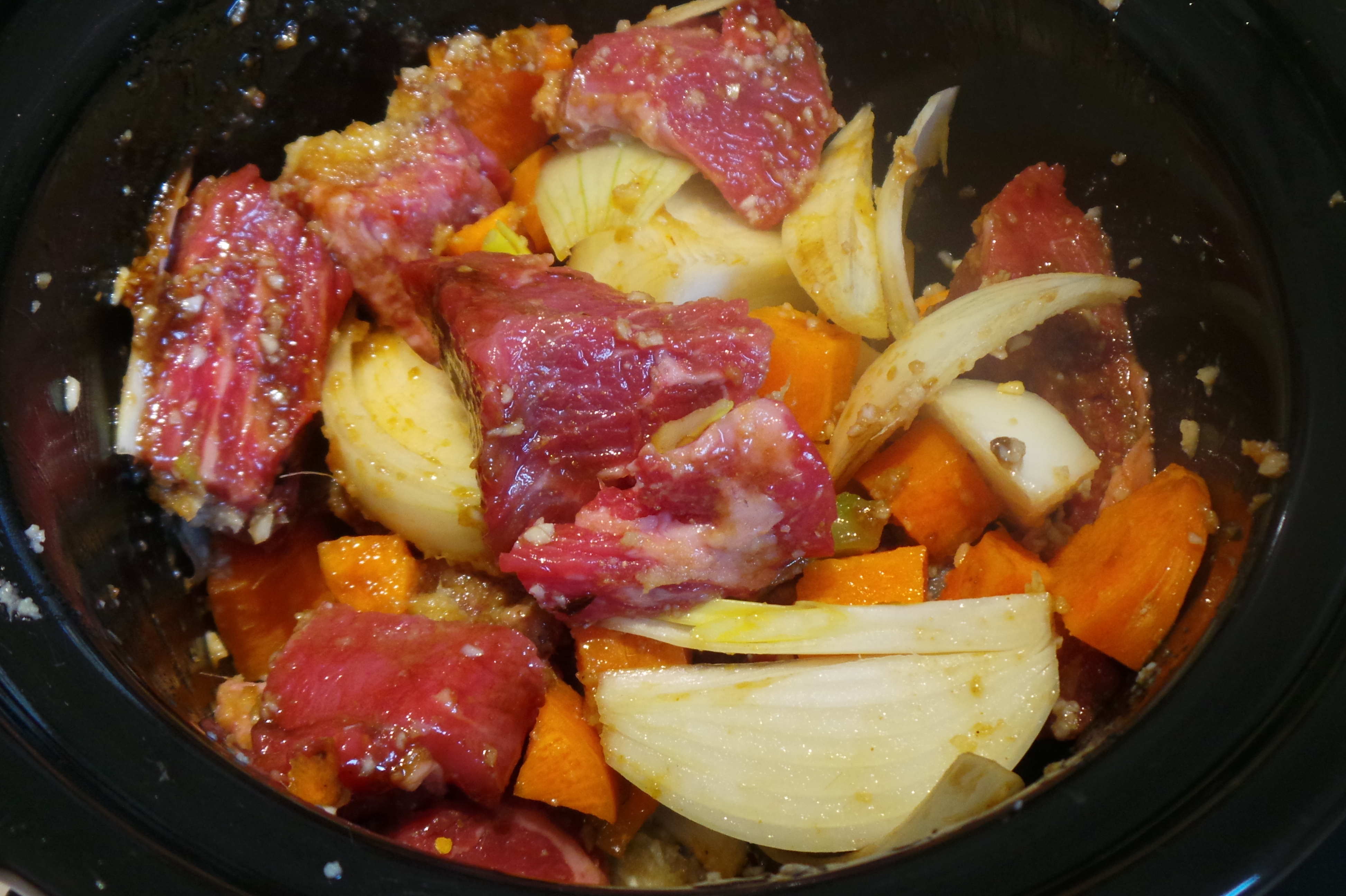
Now stir.

Stir it all together.

Stir it all together.

As you can see from the picture above, the meat and other ingredients are only lightly coated by the sauces and spices.

Using a slow cooker is a very ‘wet’ method of cooking. As the ingredients release their own juices, they are captured via condensation on the lid and then drip down into the pot to further aid cooking. Think of it as your very own little Greenhouse Effect…

Place your pot on either low or high, depending on how quickly you wish to eat. This took my small slow cooker only 2.5 hours on low. If you are making a larger amount of this in a larger slow cooker, it will take longer – possibly 4 -6 hours on low.

Several hours later...

Several hours later…

As you can see, there is quite a bit of liquid in the bowl. This can be left as it is, or thickened with some cornflour. Instructions on how to do this can be found here.

I felt that I’d like a few more vegetables in this, so I stirred through a handful each of frozen peas and frozen corn and popped the lid back on the pot for 30 minutes while I steamed some jasmine rice.

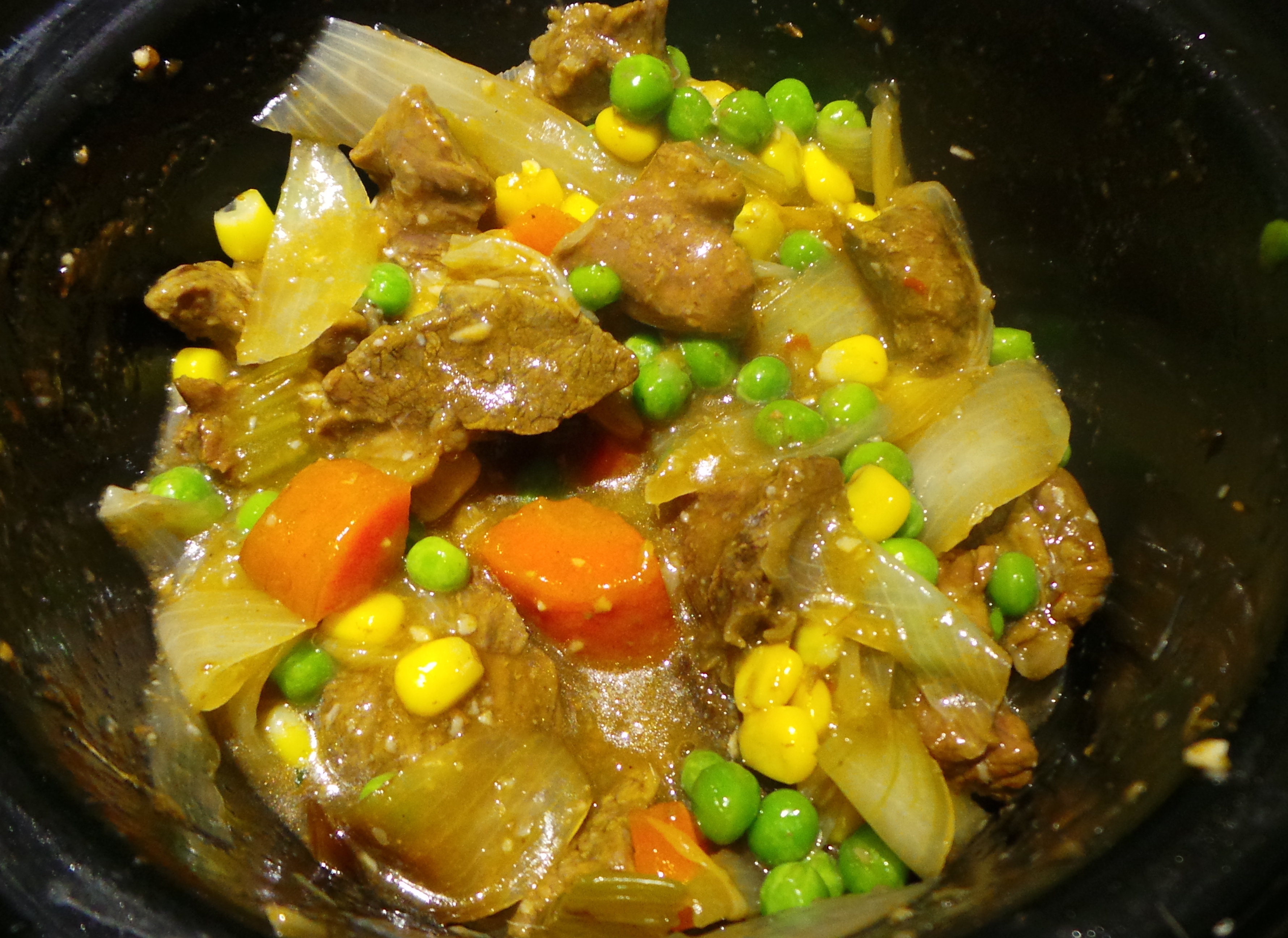
And this is the final result:

The final result

The final dish served with rice.

If you wish for a more tender version (although this is fab!) follow the instructions here and leave it overnight in the refrigerator before cooking.

Enjoy!

Freeze ahead slow-cooker beef with asian flavors

Asian-flavoured slow-cooked beef

Asian-flavoured slow-cooked beef

You know, sometimes you just can’t be bothered cooking.

Sometimes, you don’t have much to cook with

This is something that can be prepared in minutes and then left to its own devices for several hours, OR prepped in a few minutes and frozen for one of those times when you just can’t be bothered, etc.

It tastes amazing.

It smells divine.

It also costs next to nothing.

All of which is fabulous.

I like to buy chuck steak, toss it with a few spices, stir in some Asian sauces and then walk away and leave it alone.

This is how it’s done:

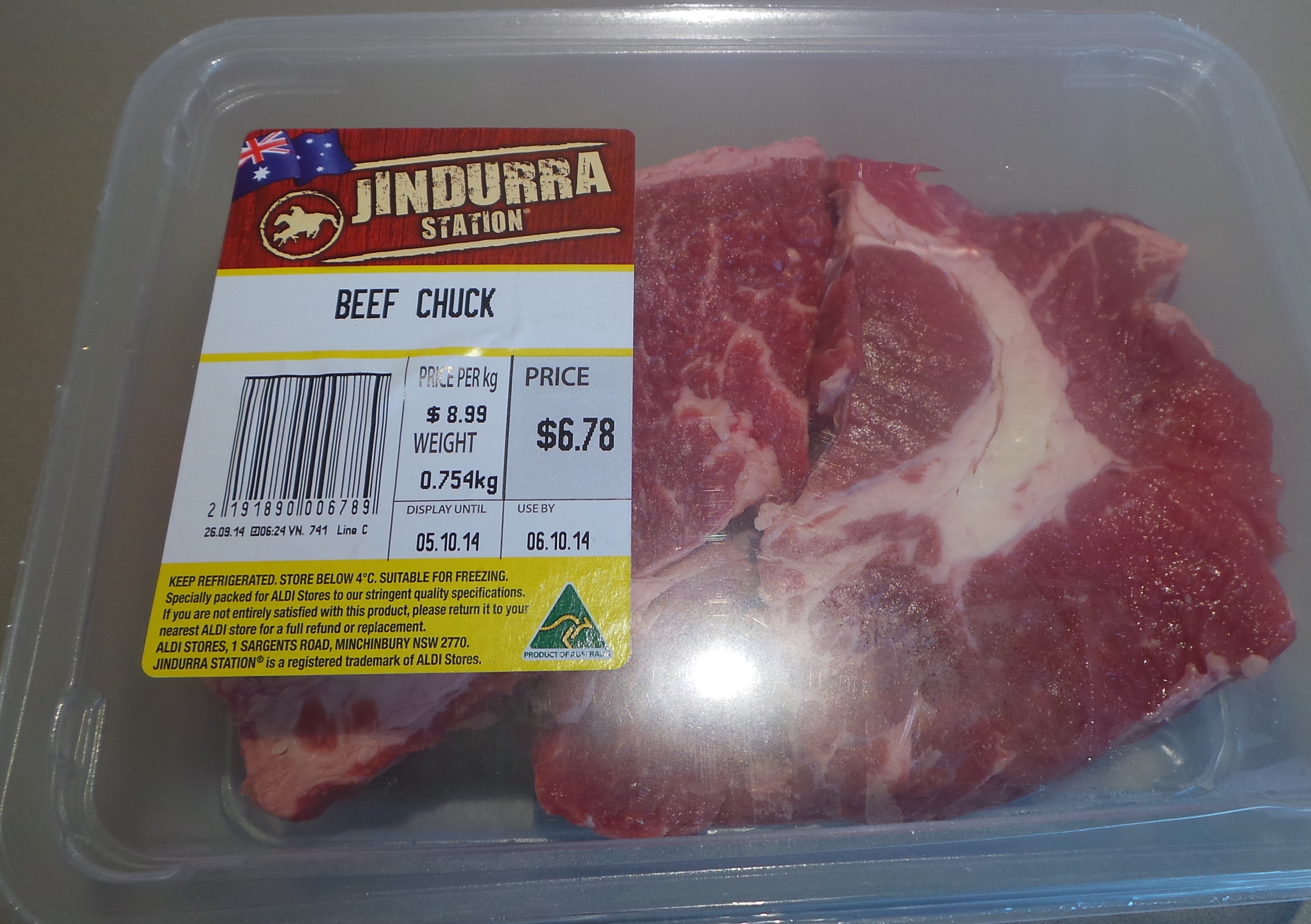
Firstly, get yourself some nice pieces of chuck steak. You don’t need much, really truly. For today’s efforts I used around 750g or 1½ pounds. That will make 2 meals for us or feed four – whichever math you prefer.

I’m going to cook half now and freeze the rest for a future I-don’t-wanna-cook-day. The rest of this post will be about the preparation for freezing.

Chuck steak

Chuck steak

I like to buy whole pieces and cube them myself, it saves a little money over buying pre-diced, but also lets me control which bits get kept and which don’t. For example, while I want the marbling in the meat on the left, I really don’t want to keep the thick streak of fat in the piece on the right… so I discard it.

The rest I cut into large cubes (about an inch a side) and divide into two portions.

Cut into large cubes.

Cut into large cubes.

Please use a sharp knife for this, chuck is not a tender cut and it can be frustrating to slice something that just won’t behave nicely on a bluntish blade.

Then I have a little fun.

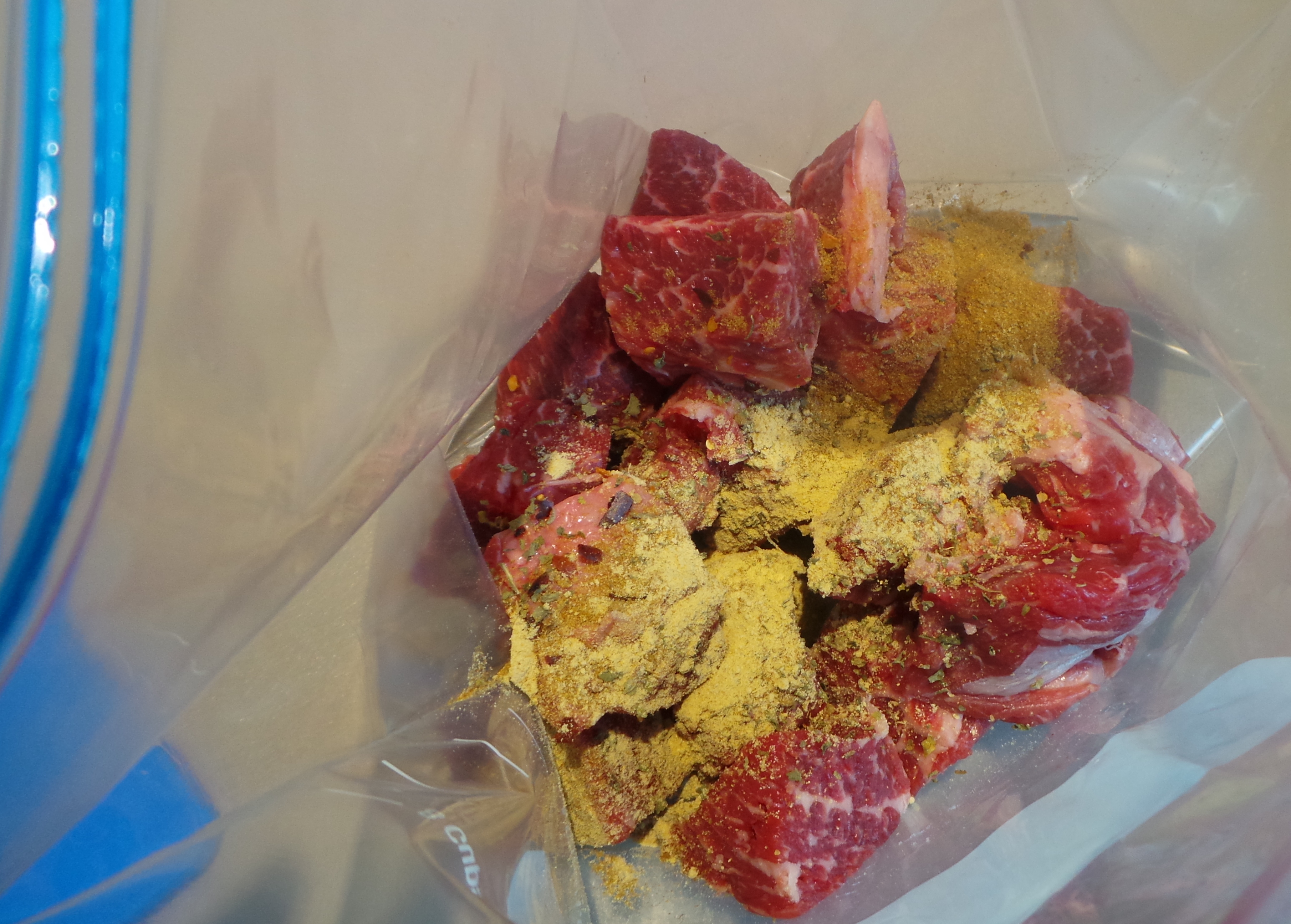
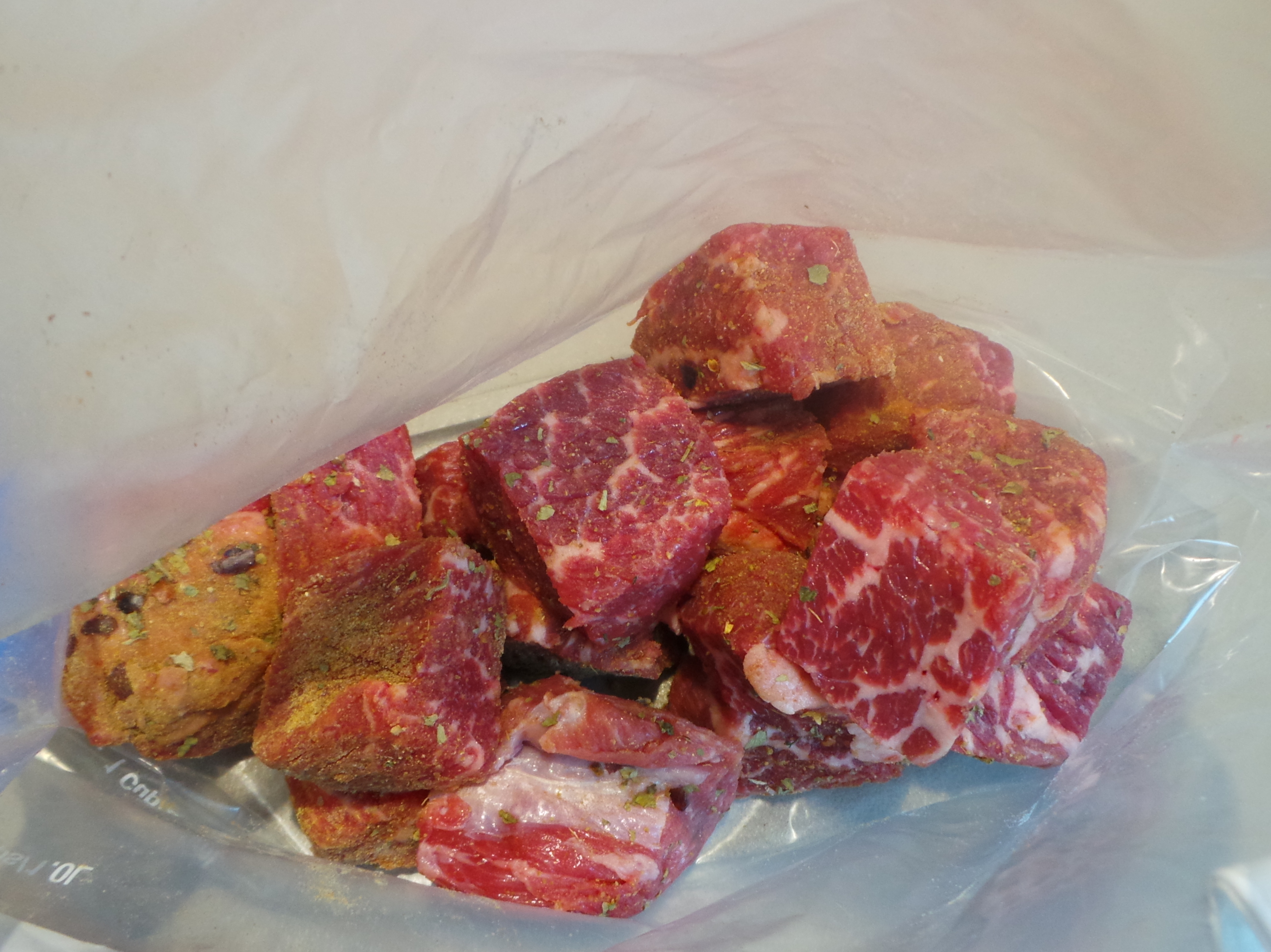
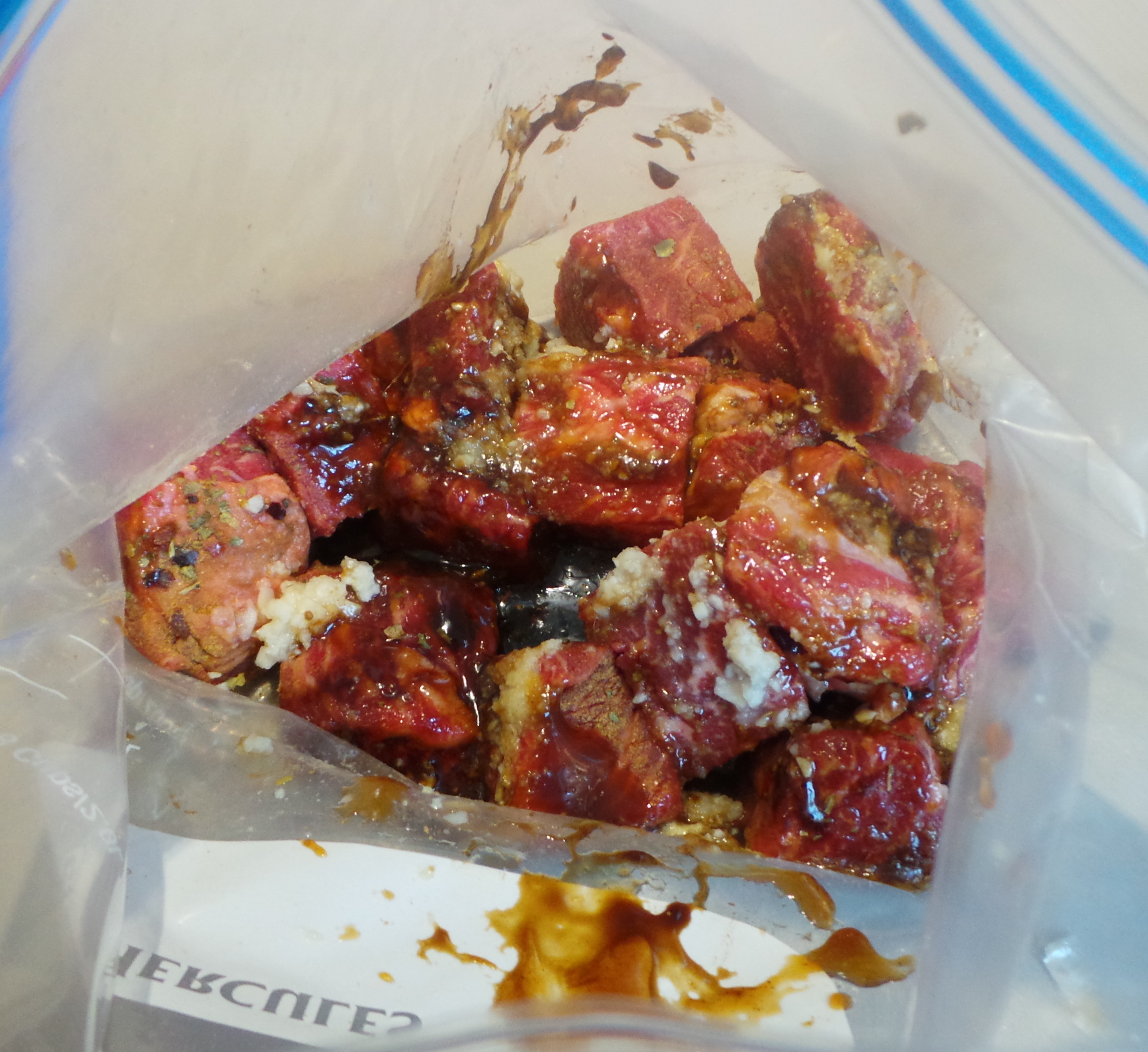
Half of the meat I pack away into a zip-lock bag for freezing and, as I do this I add a good sprinkling of whatever spices I have to hand and that I think might go well together. In this case I used ground ginger, ground coriander, ground cumin and some chilli flakes.


Add a good shake of whatever you have.

Add a good shake of whatever you have.

Seal up the bag and massage the spices through. It’s better to do it this way than to use an implement in the bag as you may pierce it and accidentally lay a path for freezer burn. That would be bad.

You can, of course, do this and all the following steps in a bowl and then bag it, but then you’d have to wash the bowl…up to you really!

Give the bag a good massage to mix the spices through the meat.

Give the bag a good massage to mix the spices through the meat.

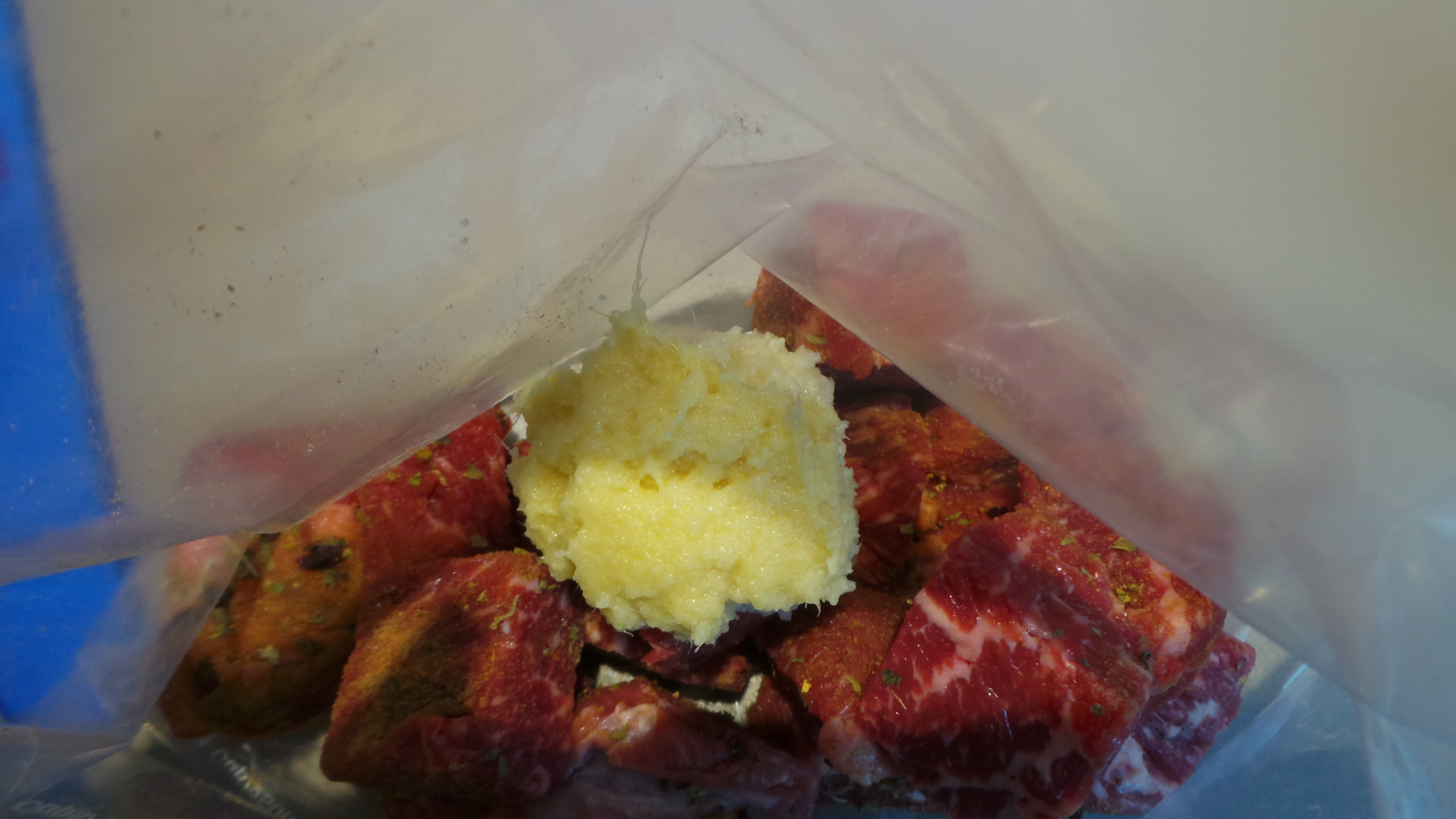
I like to then add a good teaspoon of grated ginger and crushed garlic – out of a jar.  I always have a small jar of each in my refrigerator, it saves time and it saves frustration on those days when my fingers simply won’t behave.

Add a good teaspoon each of grated ginger and crushed garlic.

Add a good teaspoon each of grated ginger and crushed garlic.

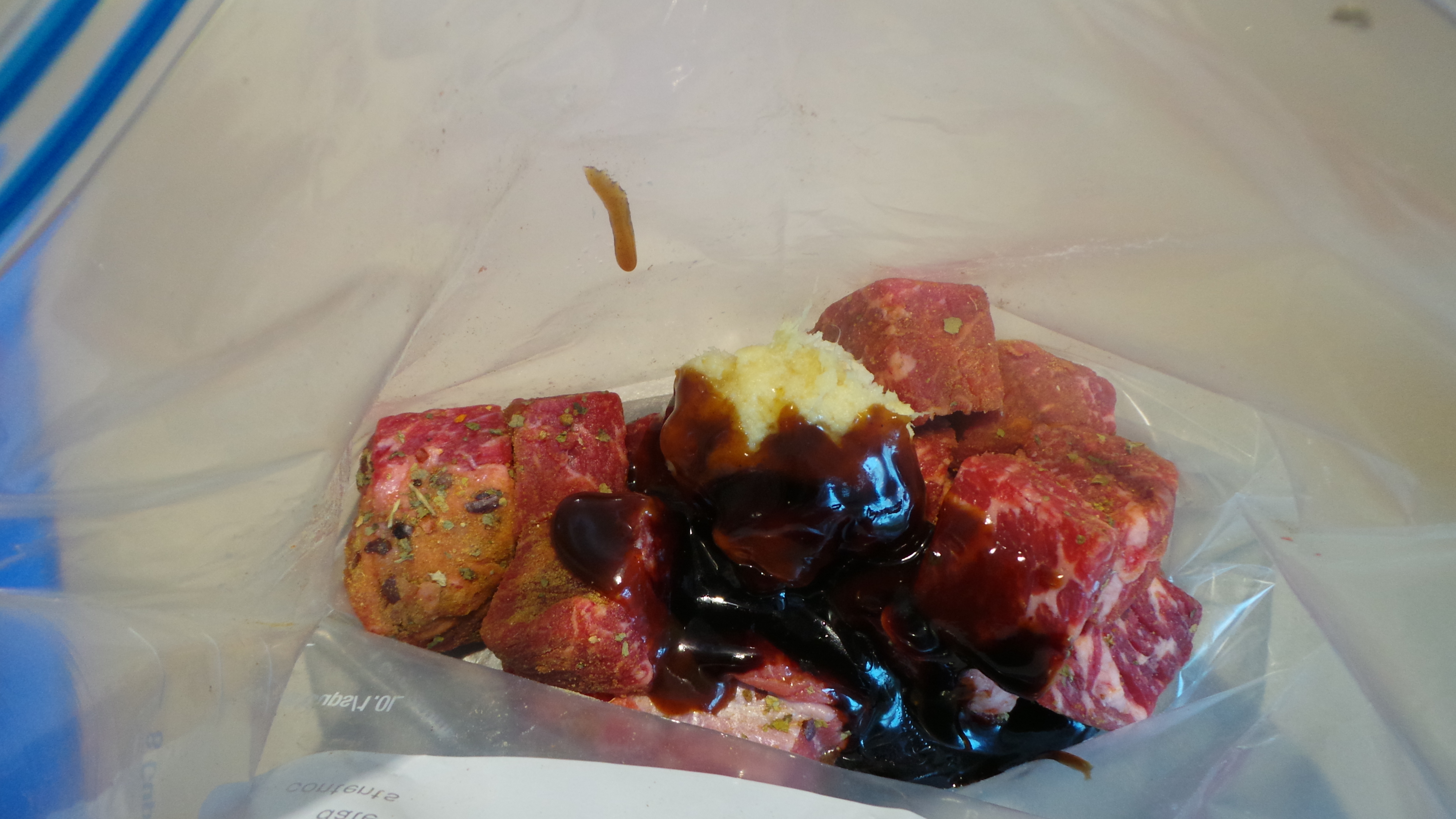
Now, grab whatever sauce tickles your fancy. You can use one sauce, or you can use several, It’s completely up to you. I used Honey Soy sauce, Hoi Sin and a glug of toasted Sesame oil; simply put a bit into the bag and repeat the massaging.

Add some minced ginger, crushed garlic and a few glugs of sauces.

Add a few glugs of sauce.

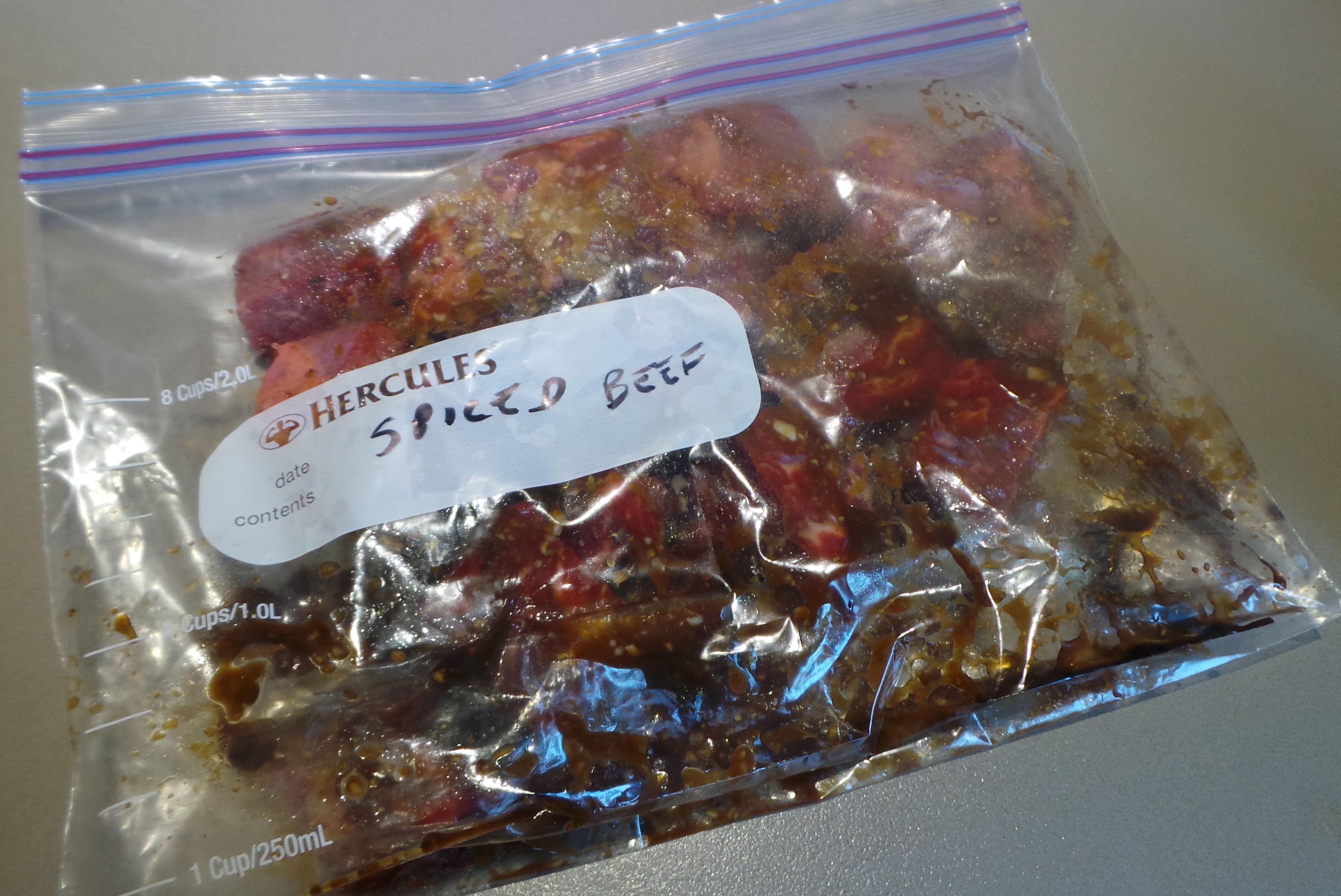
Seal the bag, excluding as much air as possible, flatten for easier storage, label and freeze.

Massage your flavours through.

Massage your flavours through.

That was traumatically difficult, wasn’t it?

Ready to freeze Asian Spiced beef

Ready to freeze Asian Spiced beef

Then, when you are ready to cook it, add a few chopped veg to your slow cooker, stir in your beef mixture, place it on low heat and leave it for around 3 hours. Serve with plain rice, or mashed potatoes.

You can add the meat mixture frozen, or let it defrost overnight in your refrigerator. The latter option will allow the meat to marinate for a few hours in all the gorgeous spices and sauces you have added.

I was going to include detailed instructions for assembling the casserole, but the post would be rather long… so, there will be another post here that describes the same recipe but cooked from fresh.

Please forgive me and click on. xx