How to cook plain old rice (without tears or a rice cooker)

Fluffy rice with flecks of spice.

Rice is one of those things that seems much harder than it is.

It makes the perfect accompaniment to umpteen million (actual measurement) other dishes, requires little to no thought or skill to pull off and can be incorporated into other dishes which make you look like an absolute star.
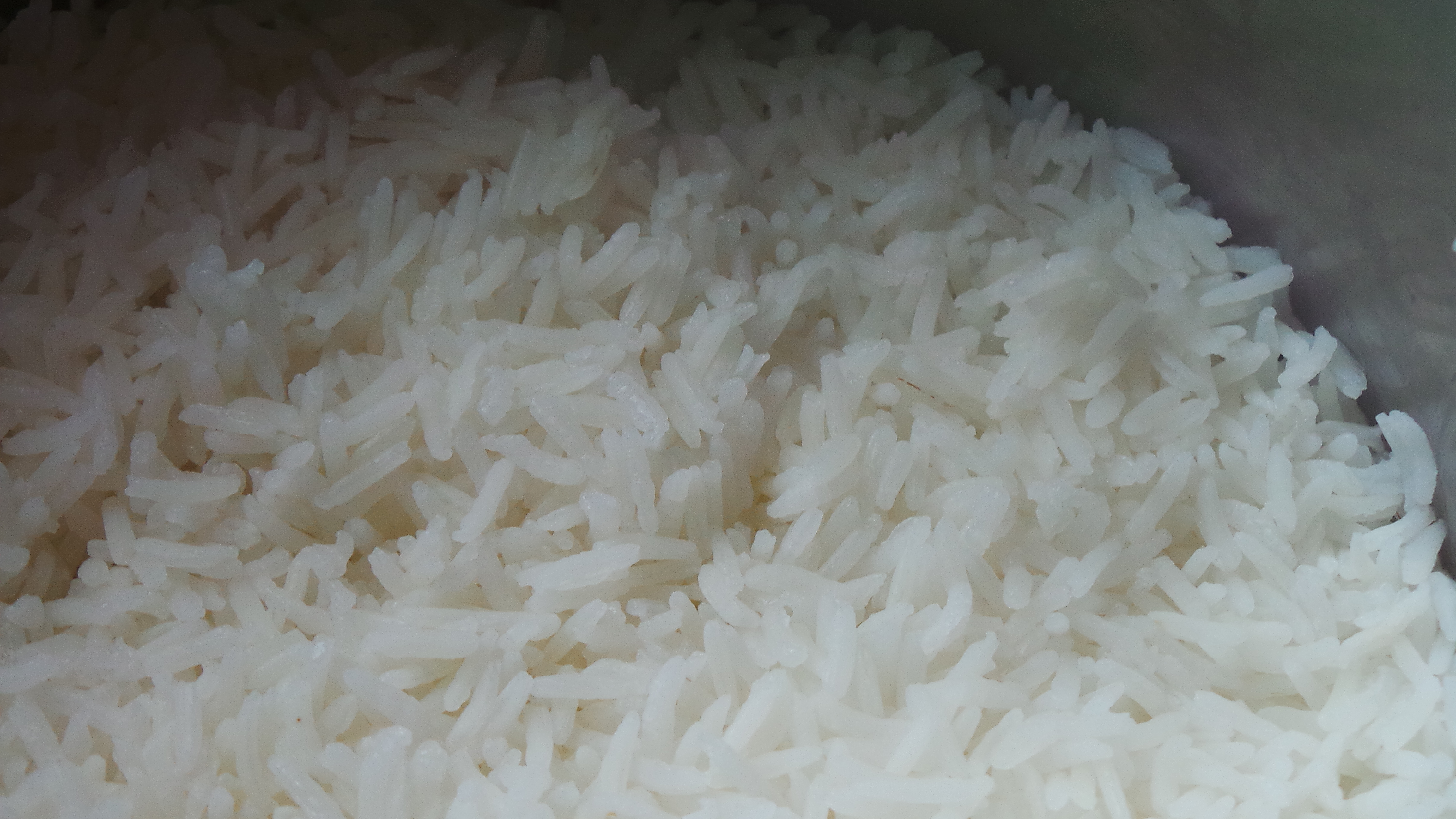
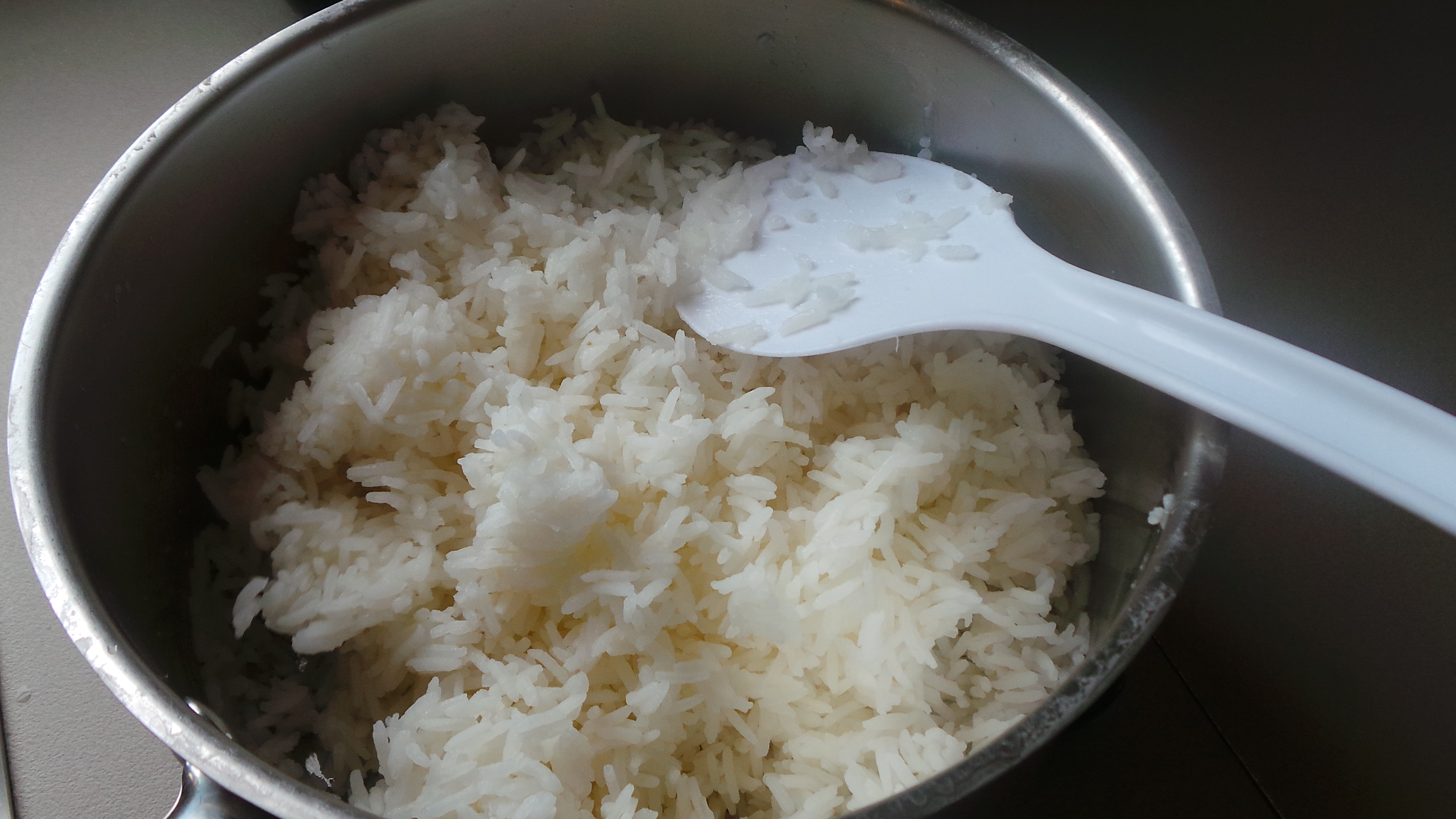
Perfectly cooked long grain rice  - without using a rice cooker.

Perfectly cooked long grain rice – without using a rice cooker.

I like to cook more than I need when I do a pot. Cooked rice keeps well in the refrigerator, reheats easily in the microwave and can be the foundation stone for other dishes like fried rice, rice salads, etc. It also makes a handy filler for things like meatloaf and rissoles (meatballs).

It’s also one of those budget booster ingredients. A kilogram of rice will only cost a few dollars but will give you three times its weight in cooked product and store in its uncooked state indefinitely if treated properly.

It can also be an absolute pain in the neck.

Pots that boil over (ugh!), rice that burns, or rice that resembles glue are all elements of everyone’s respective rice nightmares.

It doesn’t have to be that way.

Really.

It’s not rocket surgery folks and with just a little care and attention you can cook perfect rice each and every time without even using a measuring cup.

Although – if I know you guys – someone out there will *demand* that I give an actual measure somewhere. Sigh.

Not gonna. Nyah.

Take your largest pot. Fill it a quarter full of rice, cover with water to a depth that reaches halfway up your first finger joint, cover, bring to a boil, then cook on a really low heat for 15 minutes.

There. Hard innit?

Okay. Here we go again, but more slowly.

Rice triples in volume when cooked. If you want to cook a cup of raw rice, you’ll end up with three cups worth at the end. Make sure your pot will hold the finished volume of rice. That’s important.

Some may tell you that you absolutely must wash rice before you cook it. I very rarely do. If I were making rice for sushi or for something that required precise levels of starchiness, I might.

However, if your rice is processed in clean facilities, then I shouldn’t be too bothered with it for the purposes of cooking it as a side dish. It may have a few clumps in it, but they can be rectified with a fork…

Here is what the water will look like on unwashed rice…
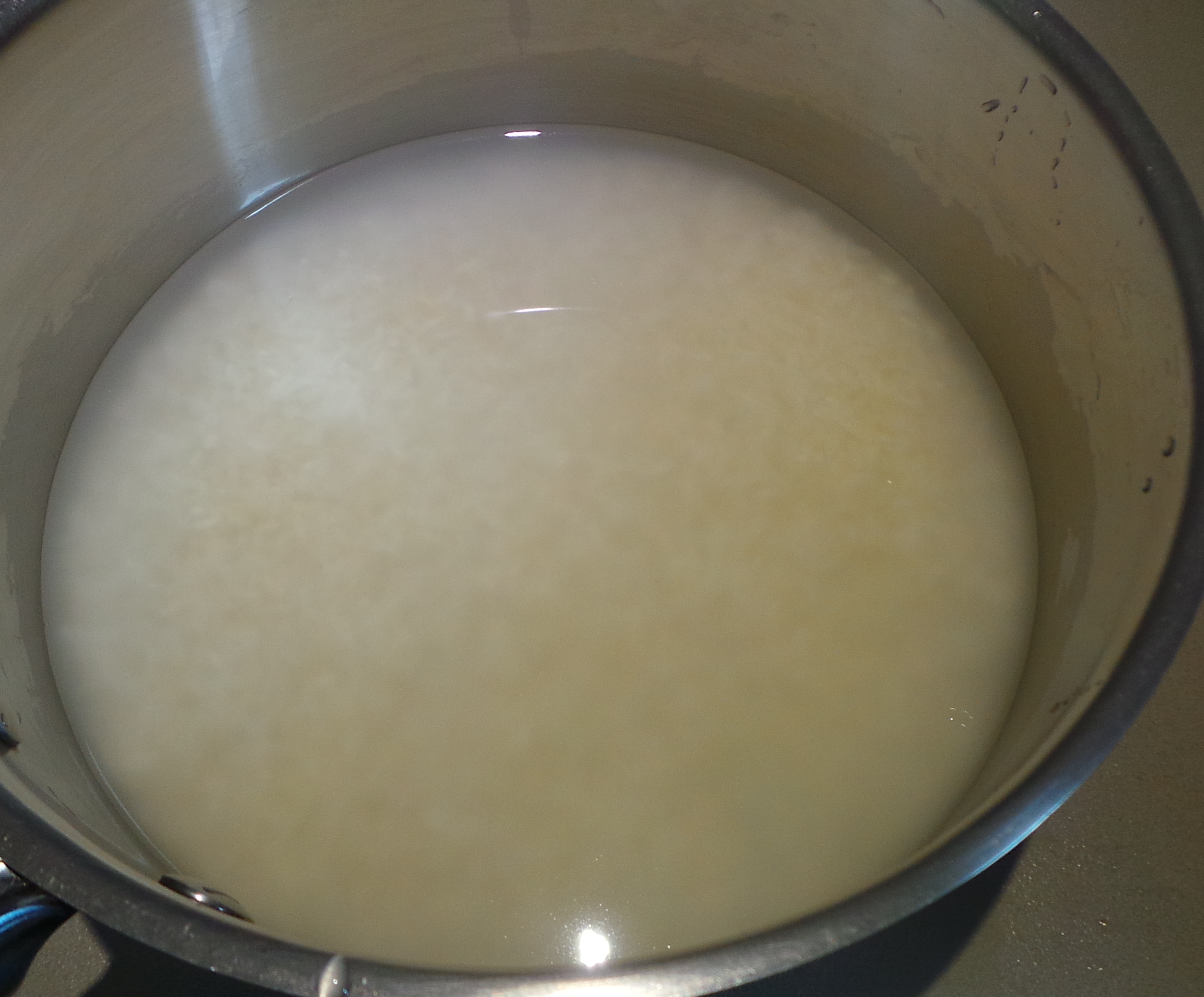
Water added to unwashed rice is cloudy.

Water added to unwashed rice is cloudy.

When it’s been rinsed a few times it becomes clearer.
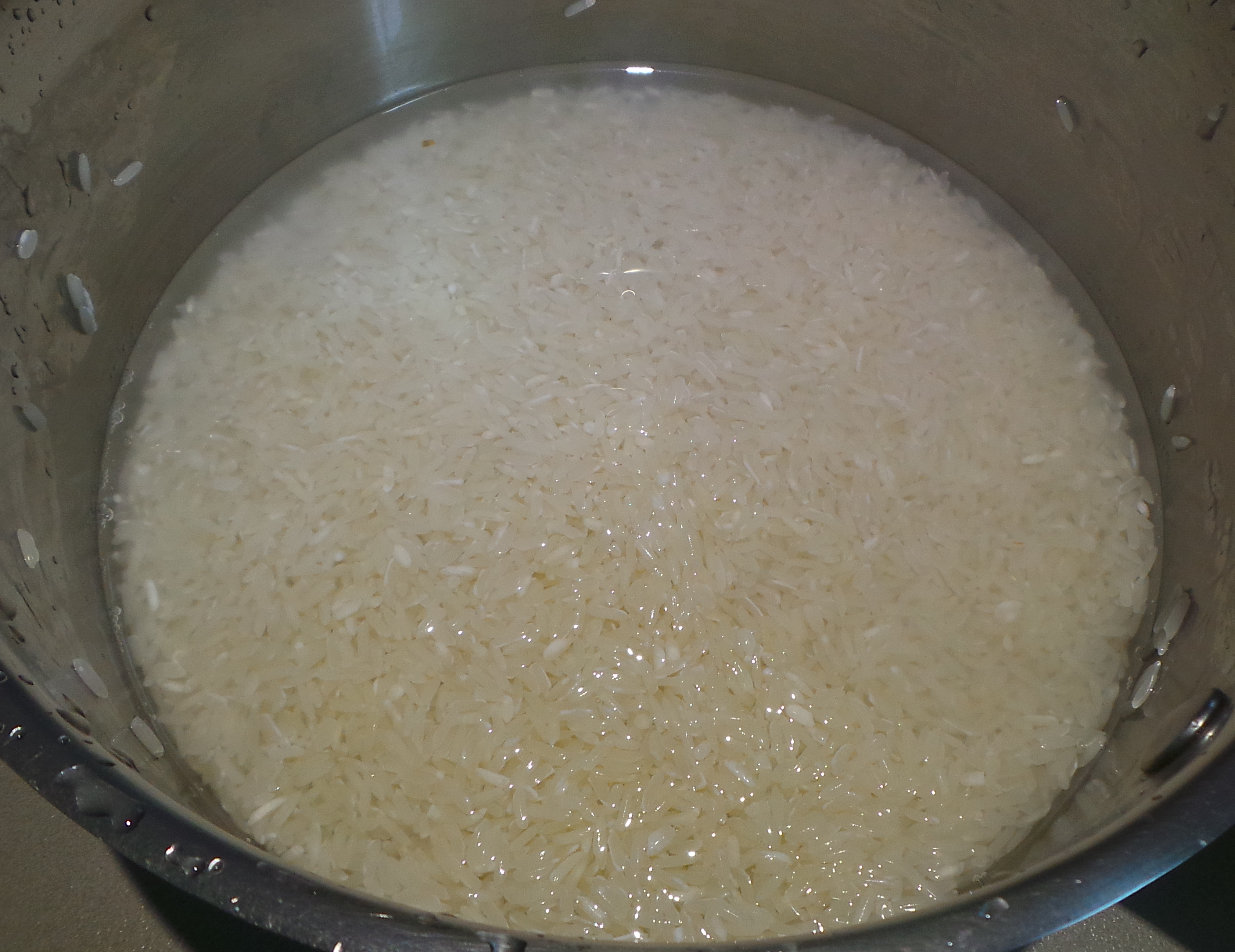
The water becomes clearer with each rinse.

The water becomes clearer with each rinse.

Not washing it will save you a colander to wash too…. (just sayin’)

You will need a saucepan with a tight-fitting lid. Don’t fret overly if it’s not completely snug – we’ll deal with that soon.

In my largest saucepan, I usually place a layer of long grain rice about an inch deep.
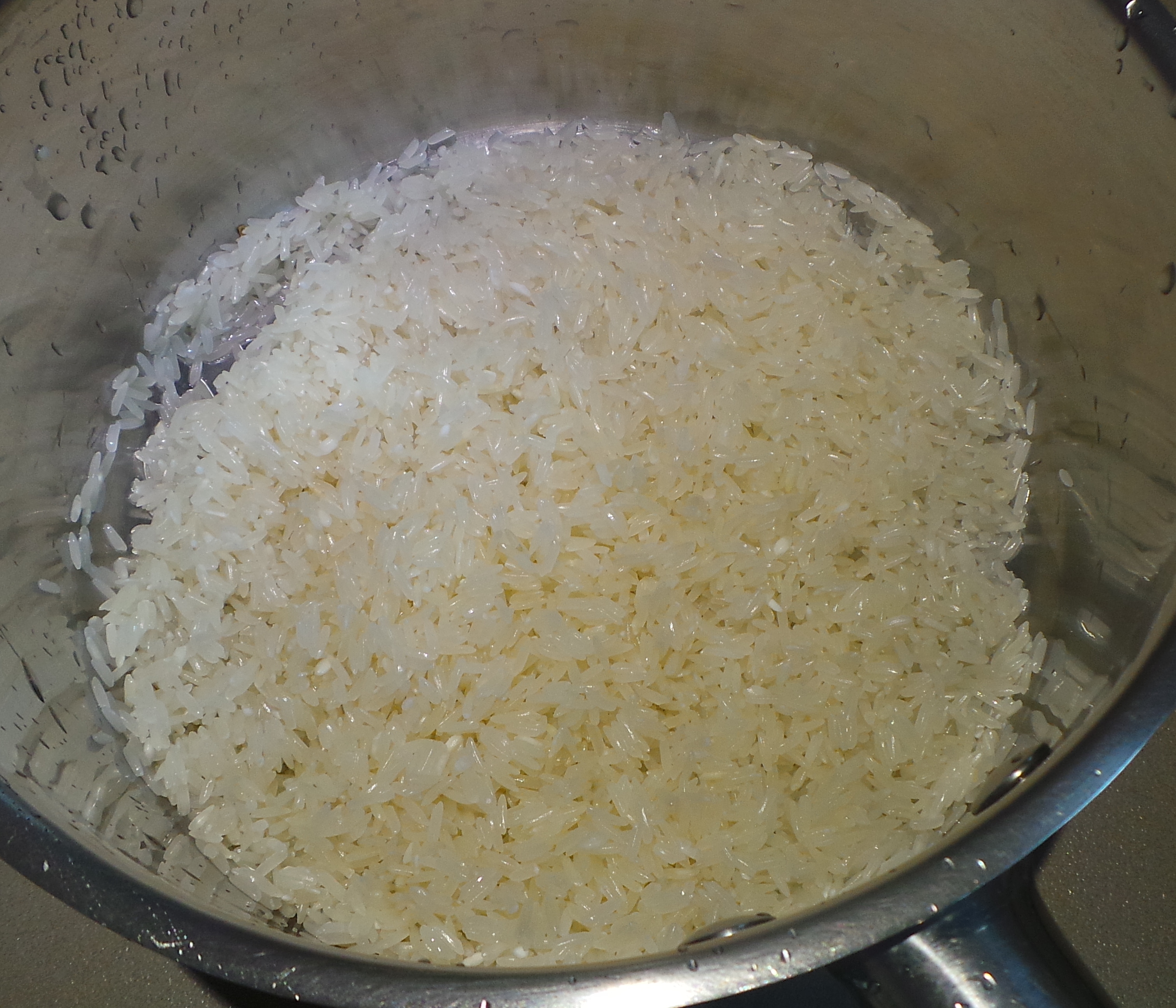
Put your rice in the pan

Put your rice in the pan (it’s wet because I just demonstrated the effects of washing it. Keep up.)

To this I then add cold water. To measure the level, I place the tip of my index finger on the top of the rice and add water until it reaches halfway up the first joint of the finger.

Like this:
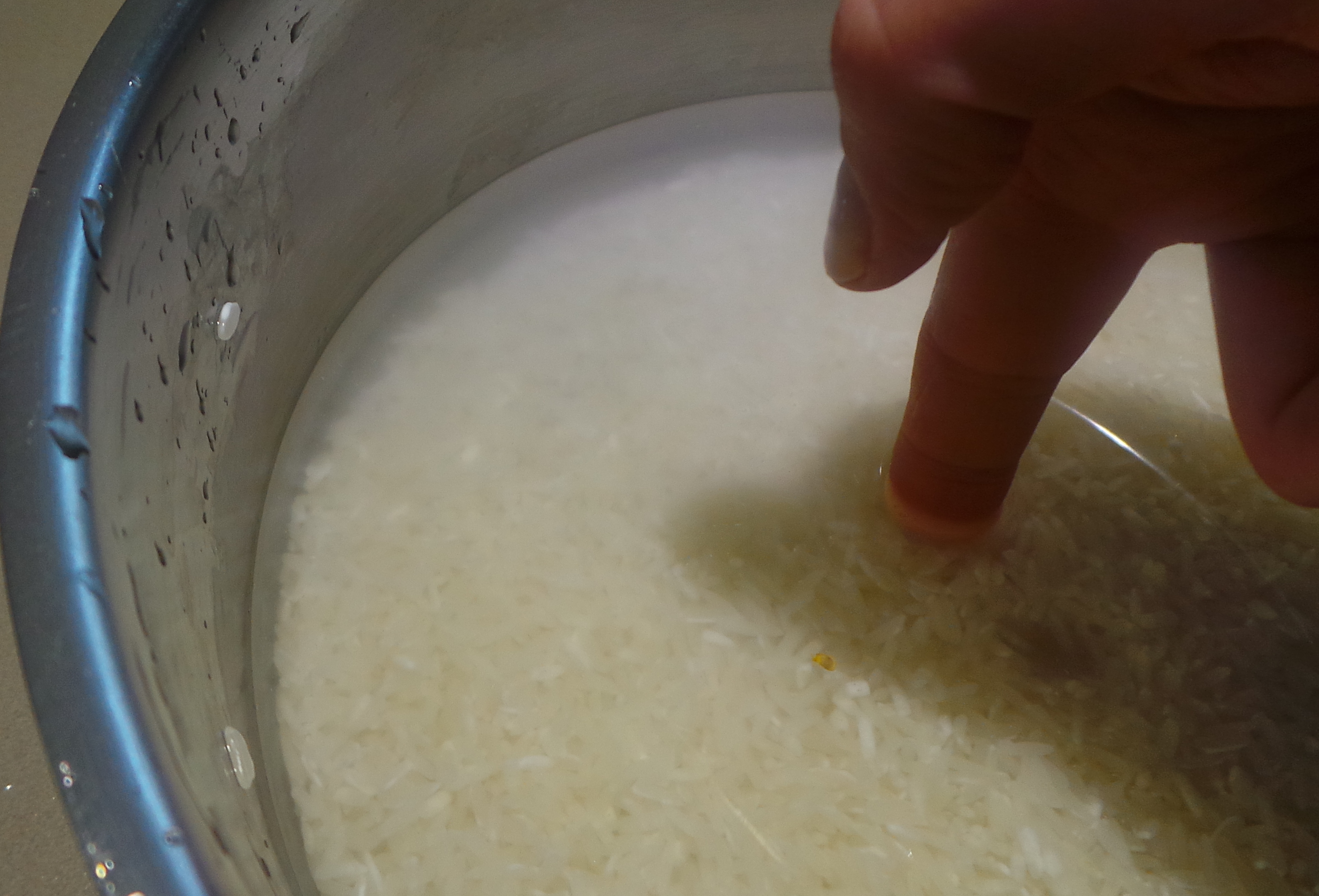
Measuring the water

Measuring the water

Then place your lid on your pot and make sure any vents are closed.

The lids of my saucepans have small holes in them to vent steam. I want to keep the steam in, so I place a sheet of baking paper or parchment over the pan and under the lid.

Use a sheet of parchment paper to seal off any leaks of heat and water.

Use a sheet of parchment paper to seal off any leaks of heat and water.

Then jam the lid on as securely as possible.

Put the lid on firmly and resist moving it until the rice is cooked!

Put the lid on firmly and resist moving it until the rice is cooked!

Do not move it from here on.

I mean it!

Place it on the hob and turn the heat to full. Do not walk away.
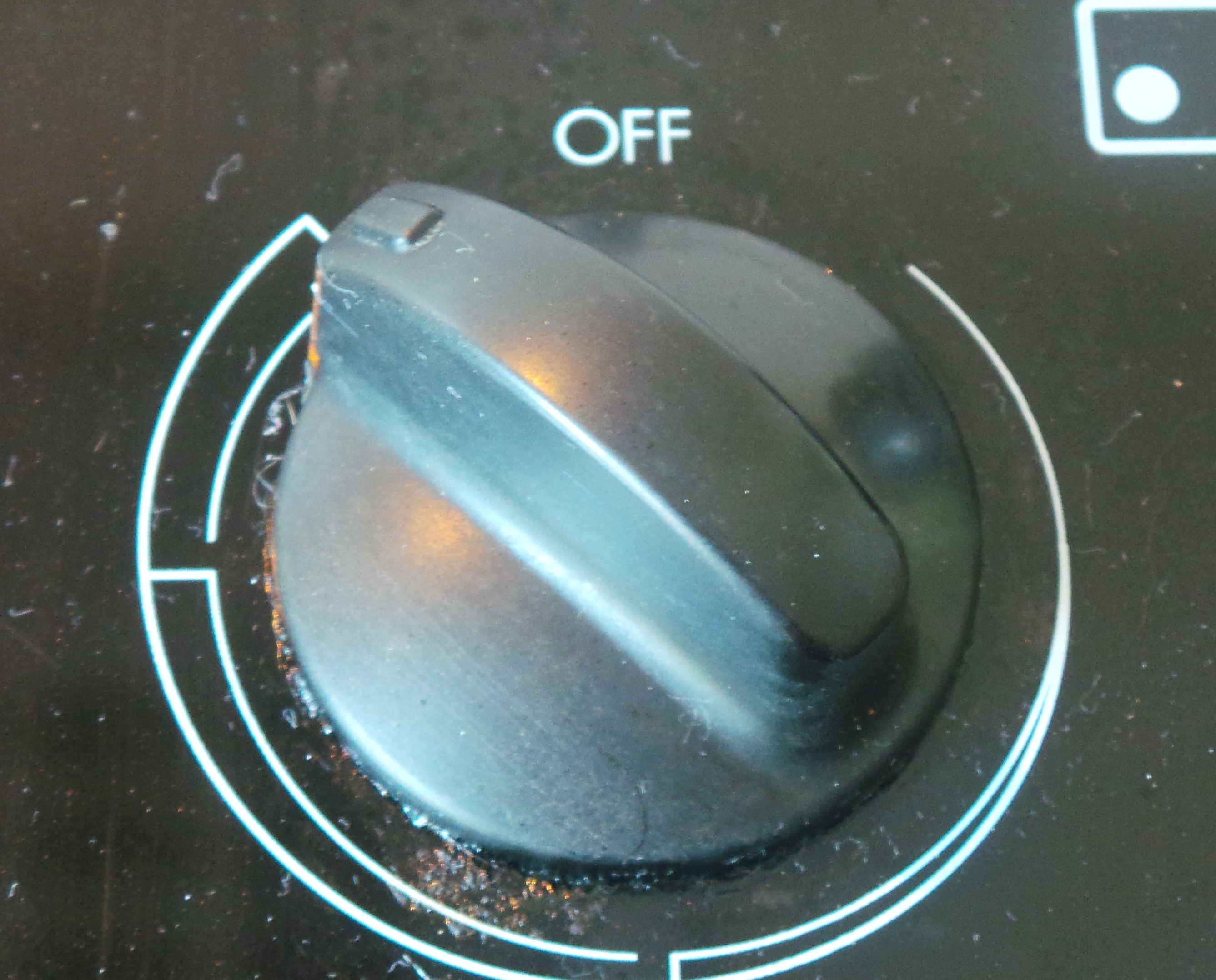
Turn your heat to full.

Turn your heat to full.

You are waiting for the rice to come to the boil at which stage you will turn it down to the lowest heat possible on your stove.

So…how do you tell if it’s boiling if you can’t lift the lid?

It’s actually very easy. Place the tips of your fingers gently on the lid handle. As the heat increases you’ll feel a slight vibration that grows as it gets closer to the boil. If you are using parchment and have a glass lid like mine, the paper will inflate as boiling point is reached.

Regardless, if you miss all these signs, you’ll know for sure as the lid tries to rock and rattle its way off your pot.

Turn the heat to the lowest point you can without turning your stove off.
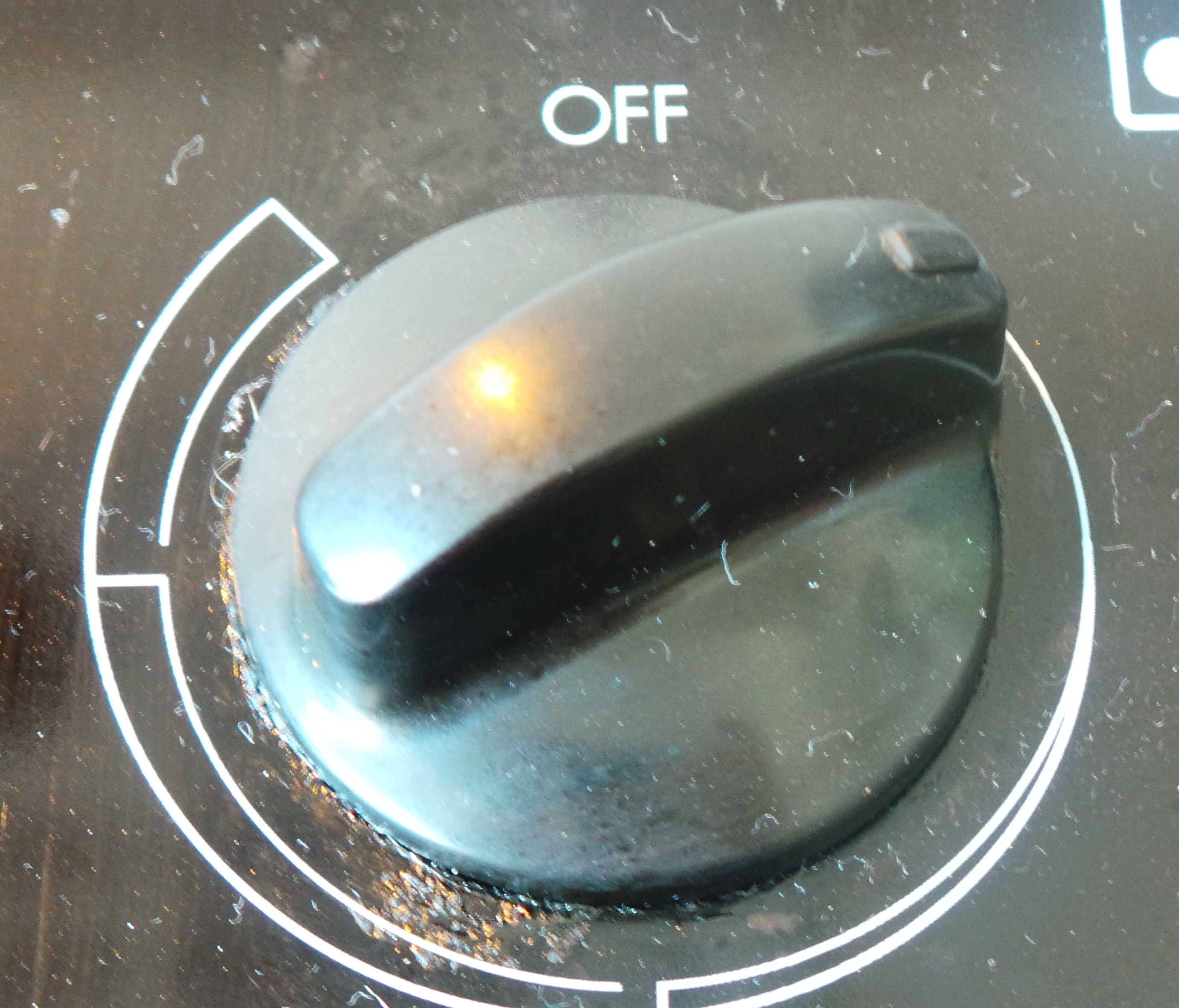
Turn your heat to the lowest level you can.

Turn your heat to the lowest level you can.

In fact, you could probably remove it from the heat altogether and not have any problems. It would just be a little less fluffy.

Not kidding.

Just don’t lift the lid!

Set a timer for 15 mins and walk away. Have a cup of tea, put away the dishes on the drainer or start prepping whatever you want to serve with the rice.

When your timer goes off, take it off the heat and leave the lid on for a further 5 minutes. If you wish, place a folded wet tea towel under your saucepan to further minimise any risk of sticking.

Lift the lid and stir with a rice paddle if you have one.
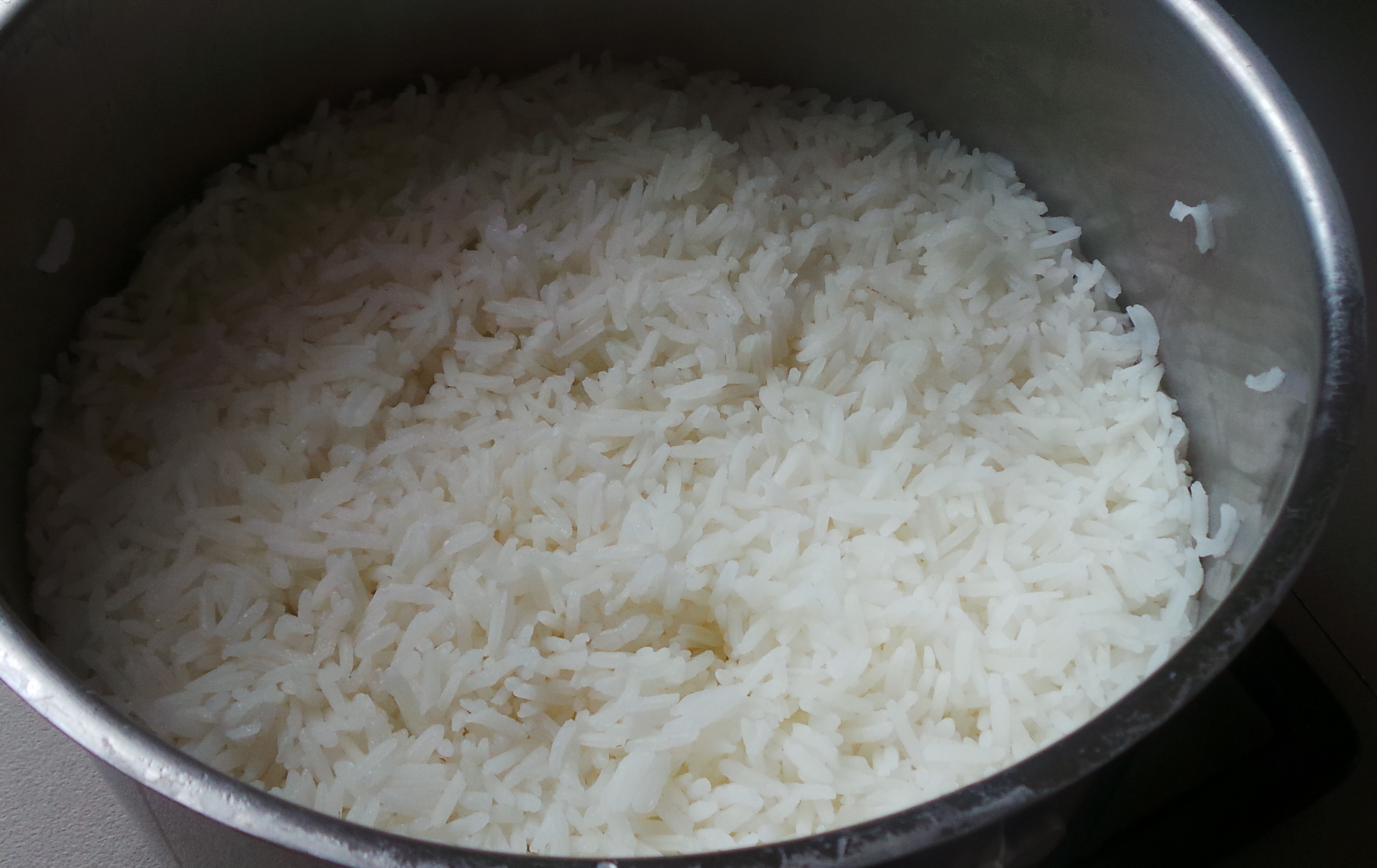
Perfectly cooked rice - without a rice cooker.

Lift your lid…


Stir your rice.

Stir your rice.

If you don’t have a rice paddle, then just use a fork. Don’t use a spoon or you will end up creating a mushy, claggy mess.

Remove the rice to a serving bowl or to a storage container as quickly as you can.

Filling your saucepan with hot water and dish soap as quickly as possible after the rice has been removed will make it a breeze to clean after you have finished your meal.

Ring the changes:

Once you feel confident in your ability to cook rice, try some very simple variations.

When you add your water also add a teaspoonful of Caraway Seeds. This makes a lovely accompaniment to rich meat dishes, especially those containing pork.

A sprinkle of caraway for flavour and fragrance

A sprinkle of caraway for flavour and fragrance.
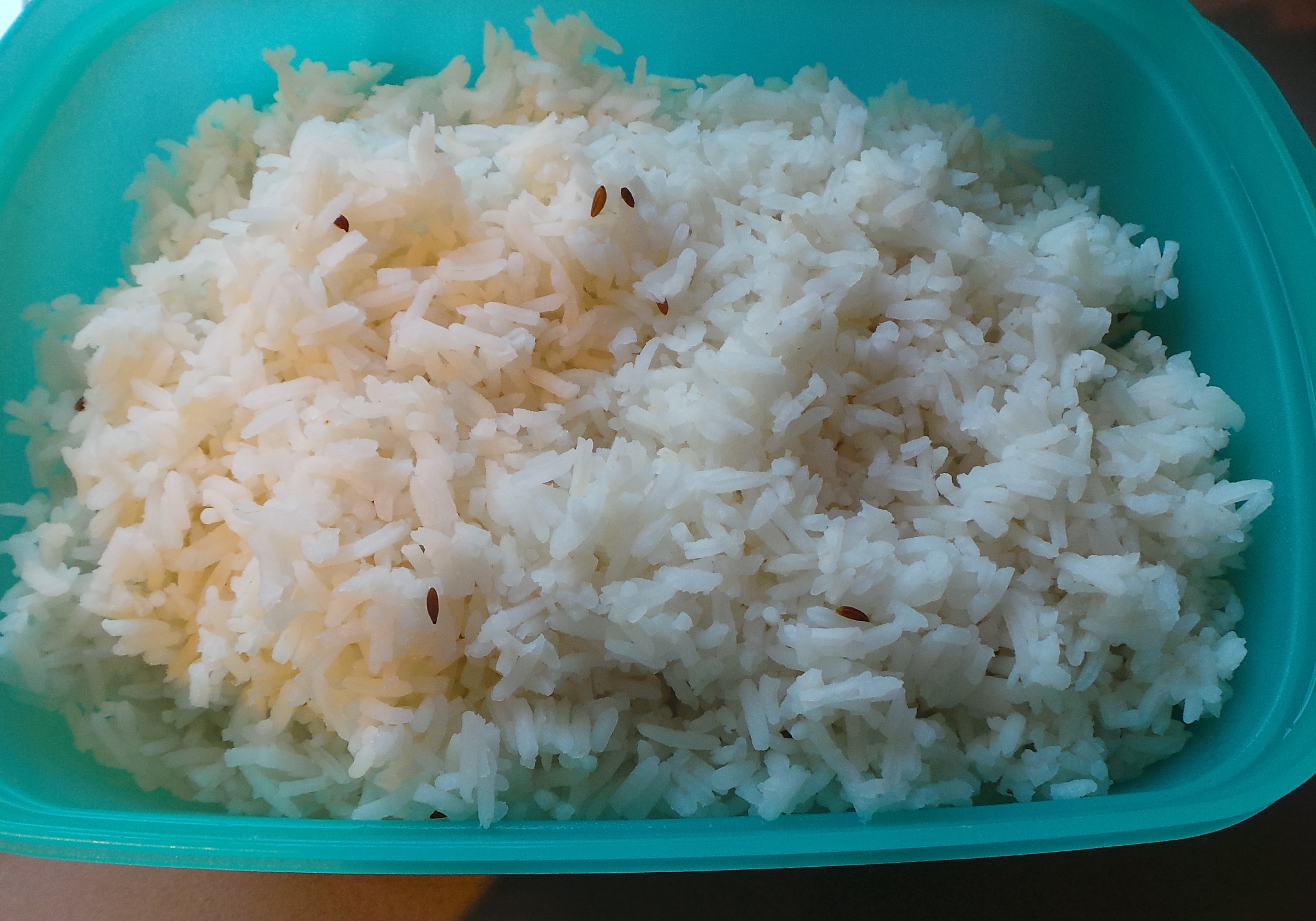
Fluffy rice with flecks of spice.

Fluffy rice with flecks of spice.


Or try a dash (maybe a ½ tsp) of turmeric instead. This will turn your rice a lovely yellow and add a beautiful, warm fragrance to the air…

Indeed, adding a touch of almost any spice will transform your rice. Try cracked Cardamom Pods, fennel seeds, star anise or – if you are feeling particularly affluent – soak a few saffron threads in warm water for 5 mins before adding them in the same way.

Use any left over rice in my Almost Genuine Fried Rice dish.
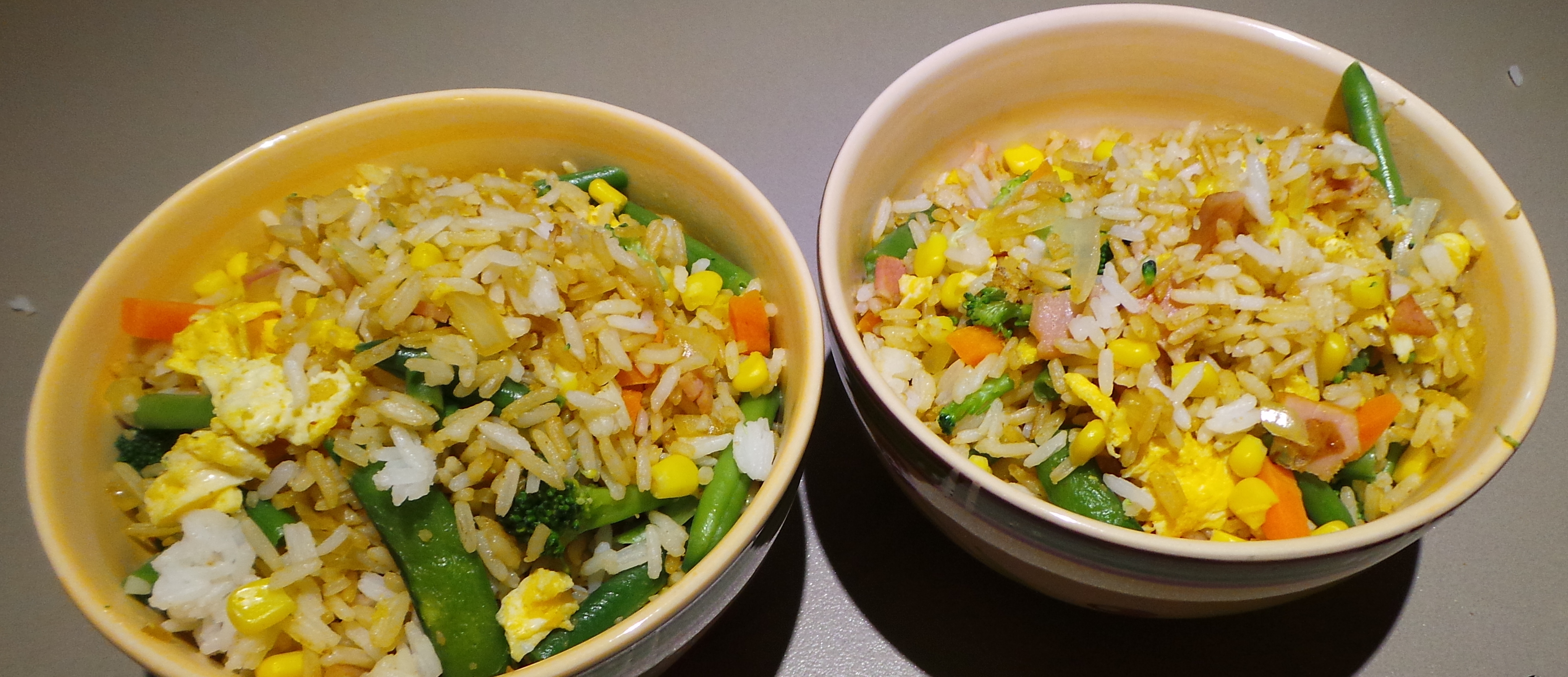
Almost Genuine Fried Rice

Almost Genuine Fried Rice

Let me know how you go!

Porridge (microwave)

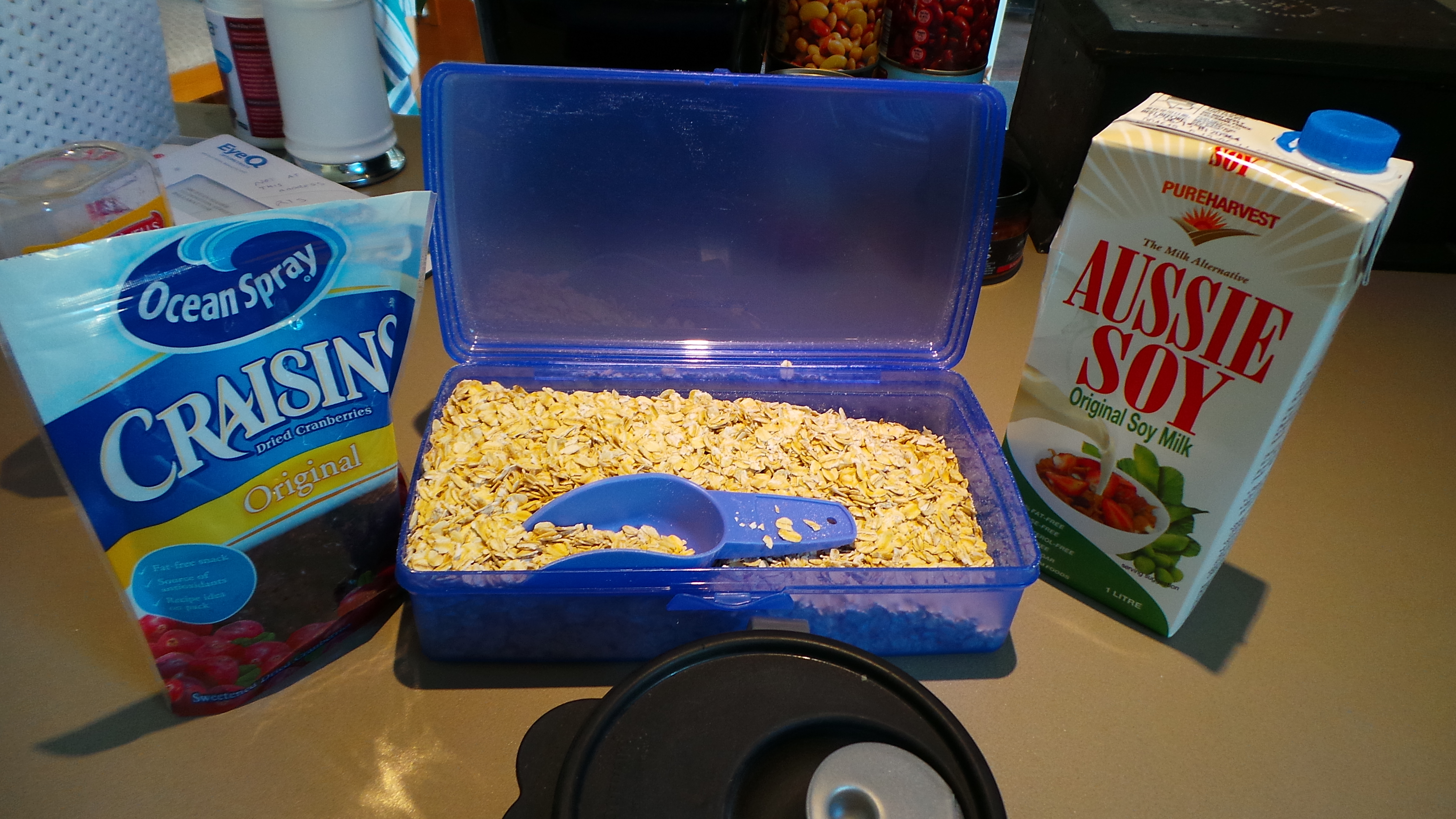
All you need for porridge

Well, I’m back.

I’ve had a number of technological nightmares with the latest being a computer that doesn’t know what to do with .exe files. If you don’t know about computers, then suffice it to say that that’s BAD. If you speak Geek, then you know just how bad it is. And exhausting.

So, to ease myself back into this blogging thingo, and to help ease any withdrawal symptoms you may have been having (Nawww!), I’m going to give you something that is about as simple as it gets.

Porridge. Microwaved porridge to be more specific.

Now I know it’s starting to warm up here in the antipodes, but some of the mornings have enough of a chill about them to still warrant a heartier, tummy-warming breakfast. In the Northern Hemisphere, Autumn has started and nothing more needs to be said.

So I’ll write a bit instead.

During the $30 Challenge, Porridge formed our staple breakfast. It’s quick, inexpensive, nutritious, fibre-laden and filling.

Many years ago, Uncle Toby’s made boxes of porridge with little sachets of different flavoured porridges. My favourite in the box was the apricot and wheat one – then they discontinued it. They kept making the product, but not with that flavour. So I thought I’d make my own.

It was then that I realised just how much more I had been paying for a tiny bit of convenience. Really, with a little planning, it is much better to make your own.

Get yourself a packet of Rolled Oats. Not Minute Oats, but Traditional Rolled Oats.

Then buy some dried fruit. This could be whatever you like; I started with diced, dried apricots and then Craisins came on the market so I used those too. You could use sultanas, dried apples, dried cherries, acai or goji berries if you have a hipster bent… It’s your meal, experiment, find your bliss.

You’ll also need liquid of some kind, be it cow’s milk, soy milk, almond milk or even water if you prefer.

All you need for porridge

All you need for porridge

I bought myself a couple of hinged lunch boxes, like the one in the photo above, and keep my oats in one and my fruit in the other. The hinged lids saved a lot of fumbling in my sleep-addled work day mornings. They aren’t strictly necessary, but they make life more comfortable.

A small scoop lives in the oat box. The one pictured was a Tupperware party favour many years ago but, for something around the same size, try saving (and washing thoroughly) the little scoop you get in boxes of laundry powder. I use two scoops per serve.

Another very useful thing is a microwaveable soup cup. The one you see in the pic is Tupperware. But you can buy much cheaper versions in any supermarket. I like these as they lend themselves to running around the house like a mad thing getting ready for work and still being able to eat breakfast before you leave…

Or make your porridge in a microwaveable bowl covered with a splash screen of some kind. You could use a piece of paper towel, but clear, plastic, reuseable ones can be bought for a dollar or so in most variety stores and supermarkets and will save you money in the long run.

So here goes. Pay attention, or you’ll miss something important.

Like breakfast.

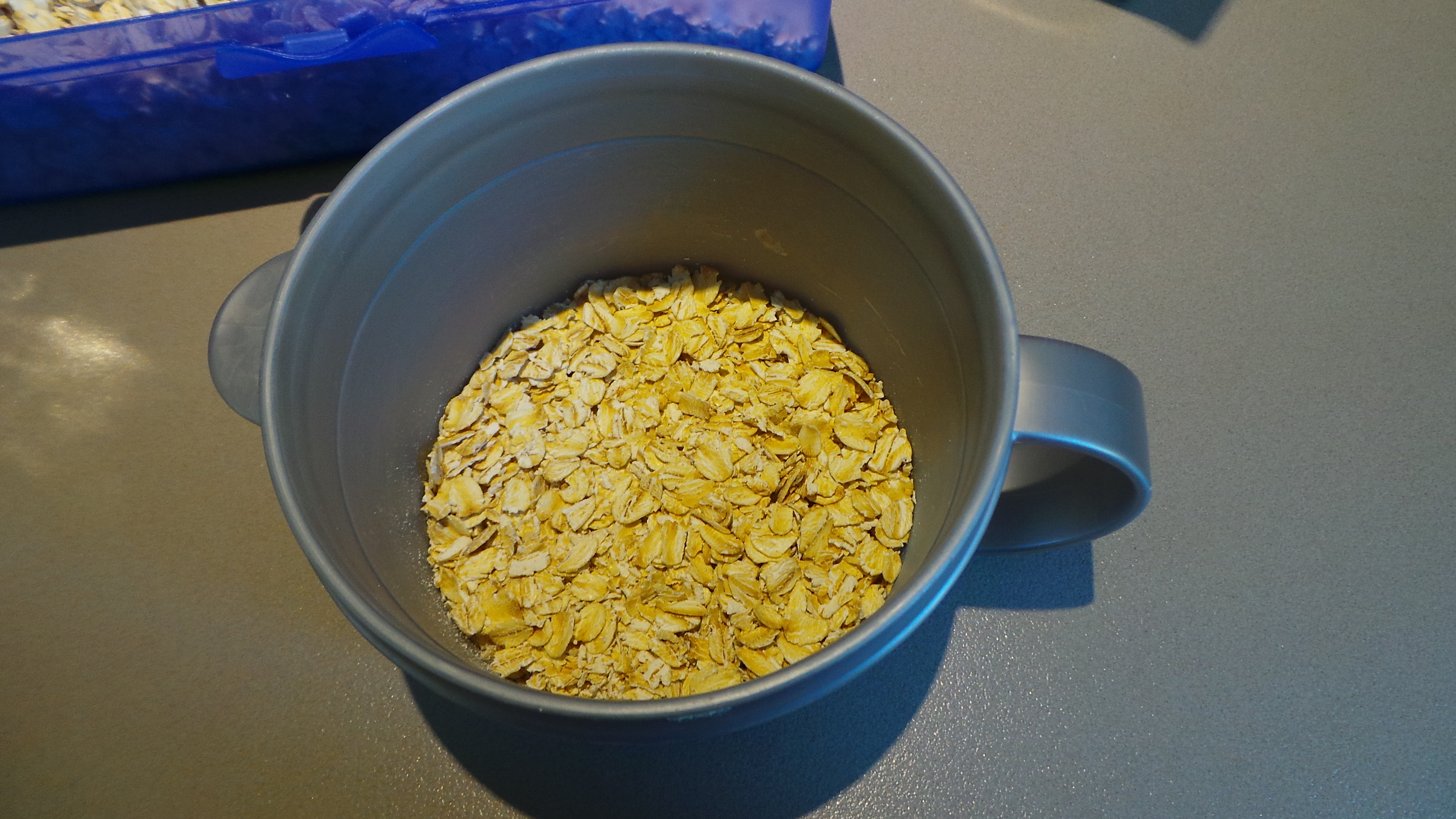
First, place your oats into your mug/bowl/whatever. Use about 1/3 to 1/2 a cup.

1/2 to 1/3 cup of rolled oats.

1/2 to 1/3 cup of rolled oats.

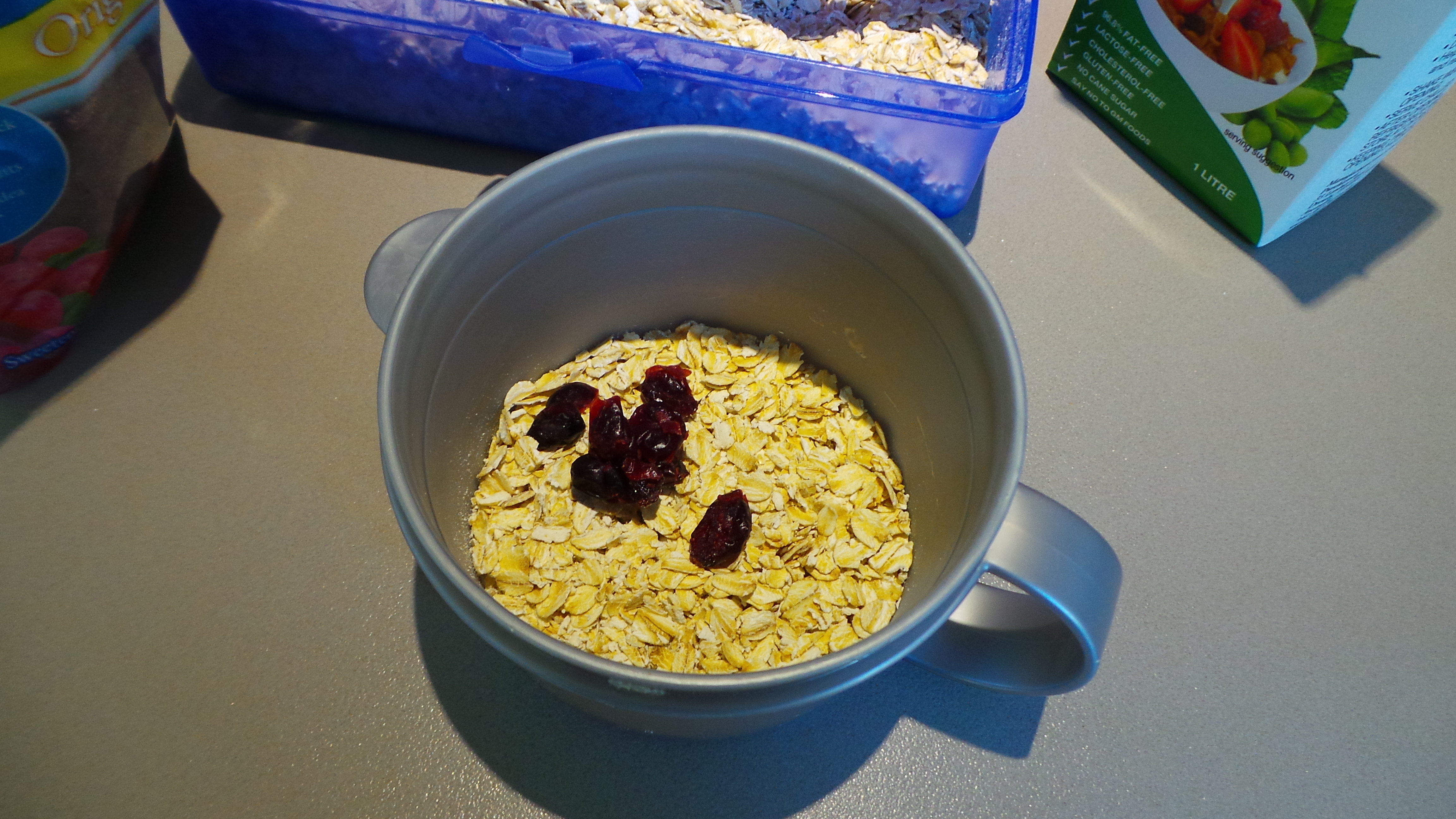
Then add whatever dried fruit you like. This is purely optional, but it does add colour, texture, flavour and sweetness – and makes it yours. You only need a pinch or so, not a huge amount. This photo shows the entire amount of fruit added.

Add a few pieces of dried fruit

Add a few pieces of dried fruit

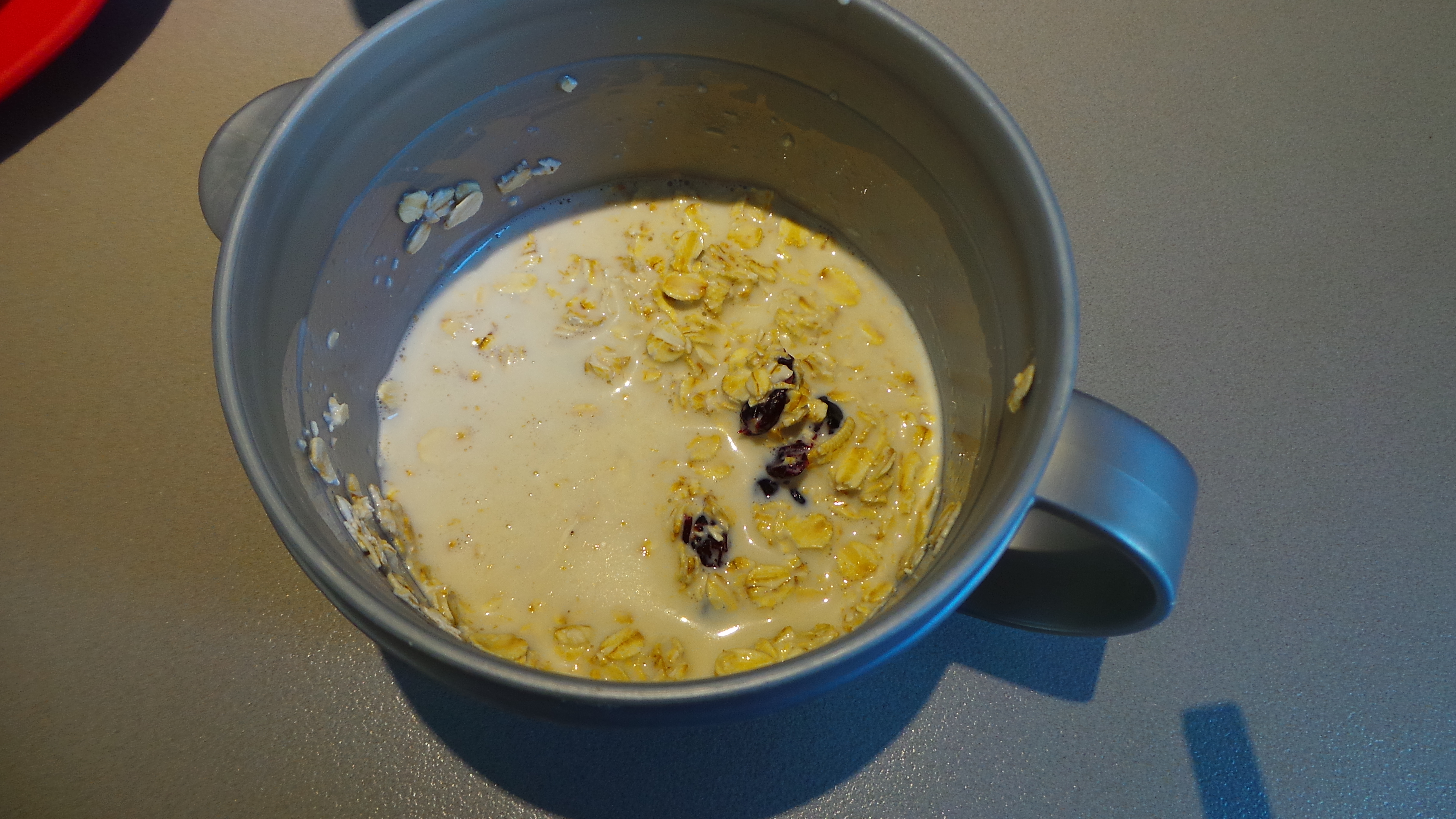
Add just enough liquid to cover the oats, stir, cover the dish and microwave at 80% power for one minute.

Add your milk, stir, cover and nuke.

Add your milk, stir, cover and nuke.

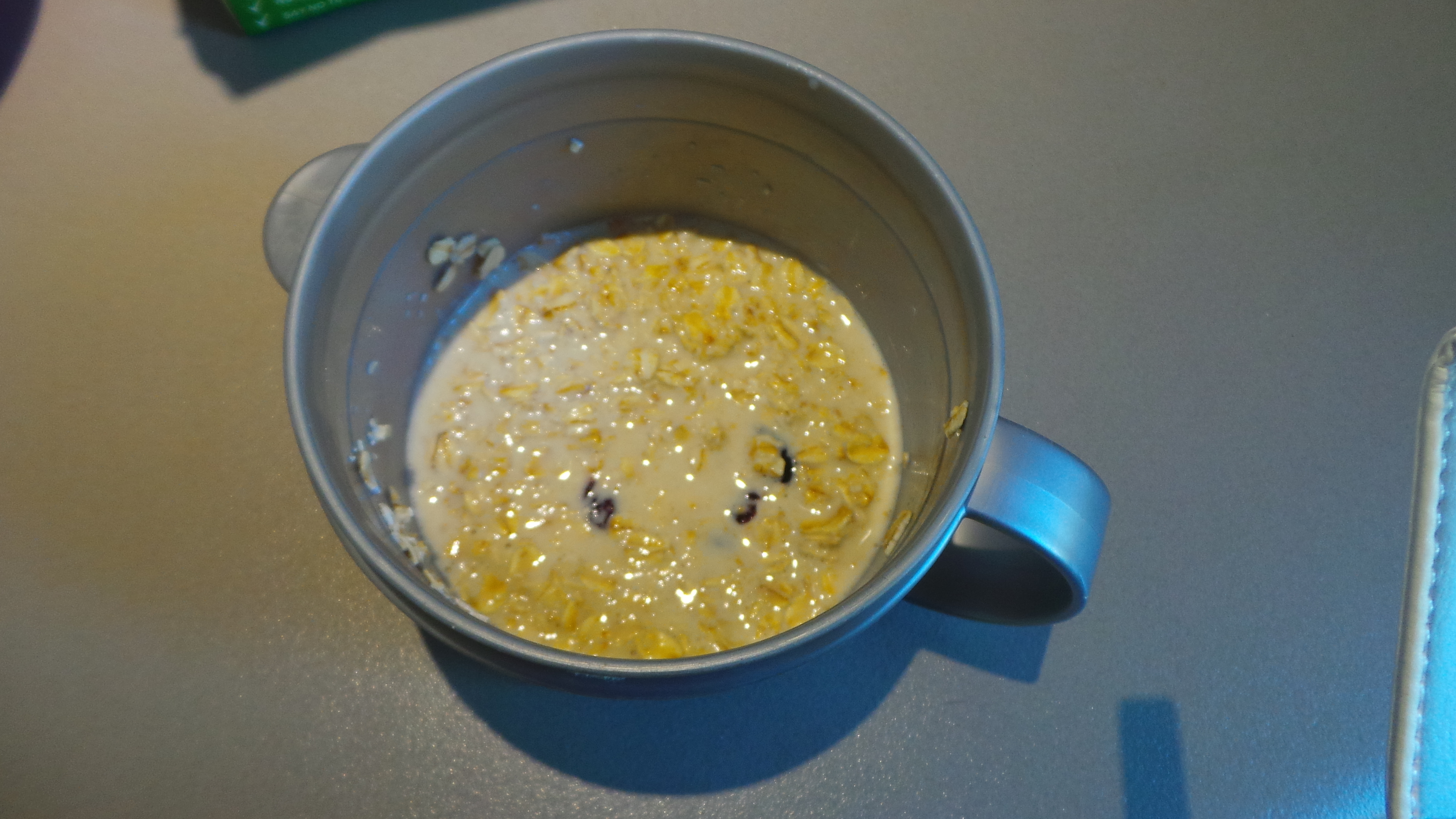
Remove from the oven, stir, add a little more milk and repeat the 80% power for one minute stage.

Done.

If your oats boil over – and this is a definite possibility – try again with either a lower power setting or shorter time. Don’t skip adding the second bit of liquid as it will help to reduce the temperature and the risk of porridge volcanoes.

The same oats, now cooked

The same oats, now cooked

The oats will continue to absorb liquid and become creamier on standing.

I used to make my oats and morning cup of tea, then shower. By the time I’d done that, both had cooled sufficiently to consume.

Feel free to add more liquid, stirring well, and some sweetener of your choice; honey, golden syrup or maple syrup work well, as does sugar of any kind – just don’t overdo it.

After you’ve finished, I would suggest filling your container with water before you rush out the door. It will be much, MUCH easier to wash when you get home in the evening.  Trust me.

If you wish to up the fibre content for any reason and you can afford it, try adding a tablespoon or so of chia to the mix. It will absorb a lot more liquid though, so be sure to compensate.

You could also just pop all the dry ingredients into your sealed soup mug and cook them up in the office if you are really pressed for time. Just remember to bring your mug home for tomorrow’s fast breaker!

So there it is.

Better yet, the amount of money that will buy you a box of sachets for 8 meals, will buy you the ingredients for several more weeks worth of home-compiled breakfasts that you can tailor to your preferences. And give you oats and dried fruit for other goodies like Anzac Biscuits and Apple Crumble.

Making Chicken Stock in a slow cooker

So, don’t you hate those people who get all snobby about stock powders that come in cubes and cans and stuff?

You know, the ones who make their own stock and simply can’t understand anyone who doesn’t?

chicken stock (2)

Yeah.

I’ve become one of them. Sorry.

I used to be the person who would reach for the Massel or the Vegeta if stock was necessary, but since I moved at the start of the year I’ve been making my own actual liquid stock and it is soooooo much better than anything I’ve ever bought – even in one of those tetra pack doovers.

The hardest part is storing it. However, since I had to buy a new refrigerator when I moved, I got a wider one with these lovely drawers in the freezer. I lovingly ladle the stock into mason jars, place them in the freezer and forget about them until I need stock for risotto, gravy or soup…

I make my chicken stock in the crock pot or slow cooker overnight.

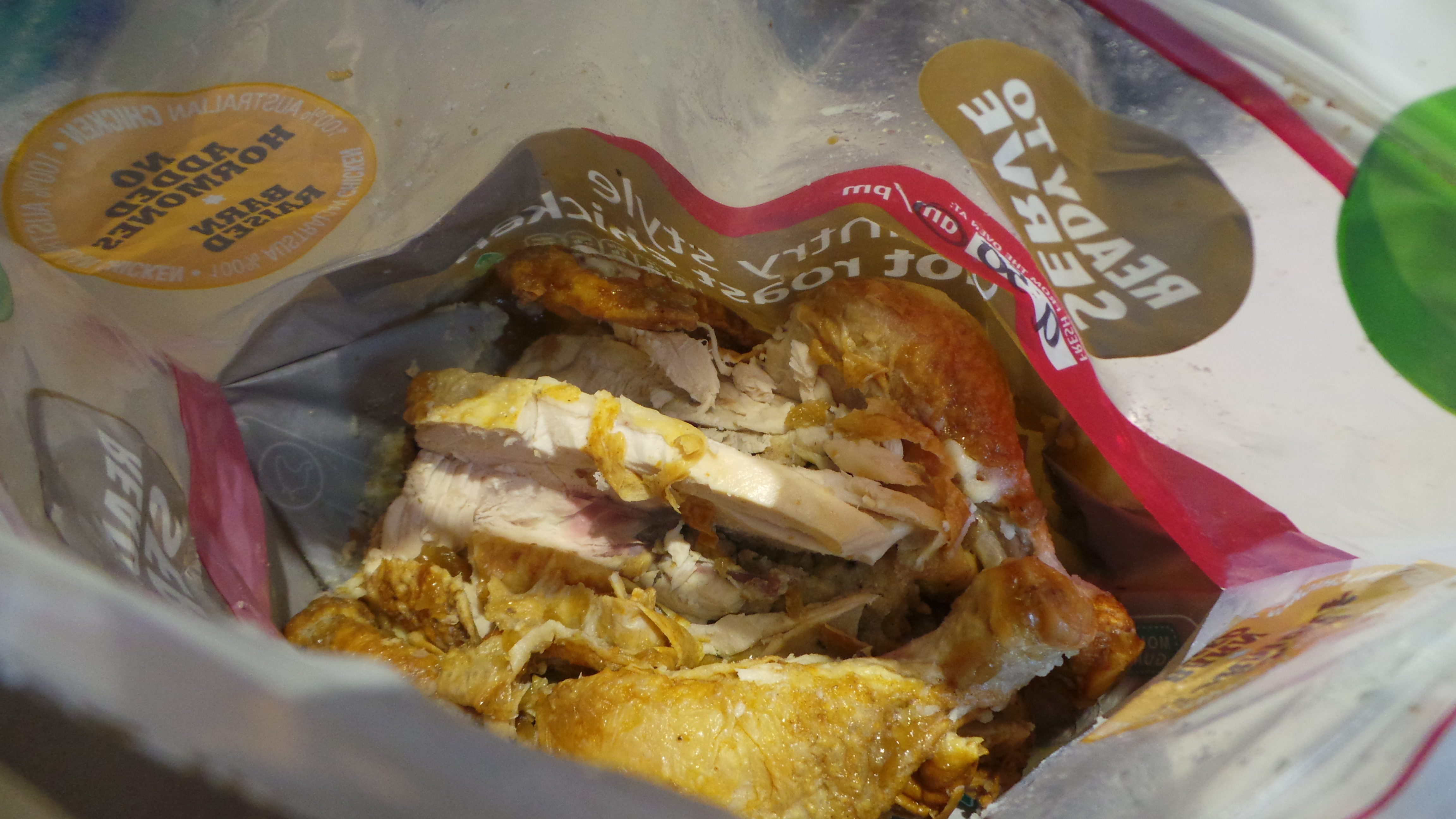
It’s terribly uncomplicated. Every now and then The Boy and I buy a BBQ Chook* from the local supermarket for one reason or another. After we’ve picked as much of the flesh as we can off it, I use it for stock. Now, if the freezer is already well stocked with…um… stock, we simply freeze the carcass until we need to restock the … stock. Follow? Good.

Leftover BBQ Chook

Leftover BBQ Chook

Making the stock goes like this:

Pop your chicken carcass into a slow cooker or crock pot. You can do this with an uncooked chicken, but a cooked one will give you far more flavour. Make sure to remove any stuffing from the cavity and dispose of it. You don’t want that in your liquid.

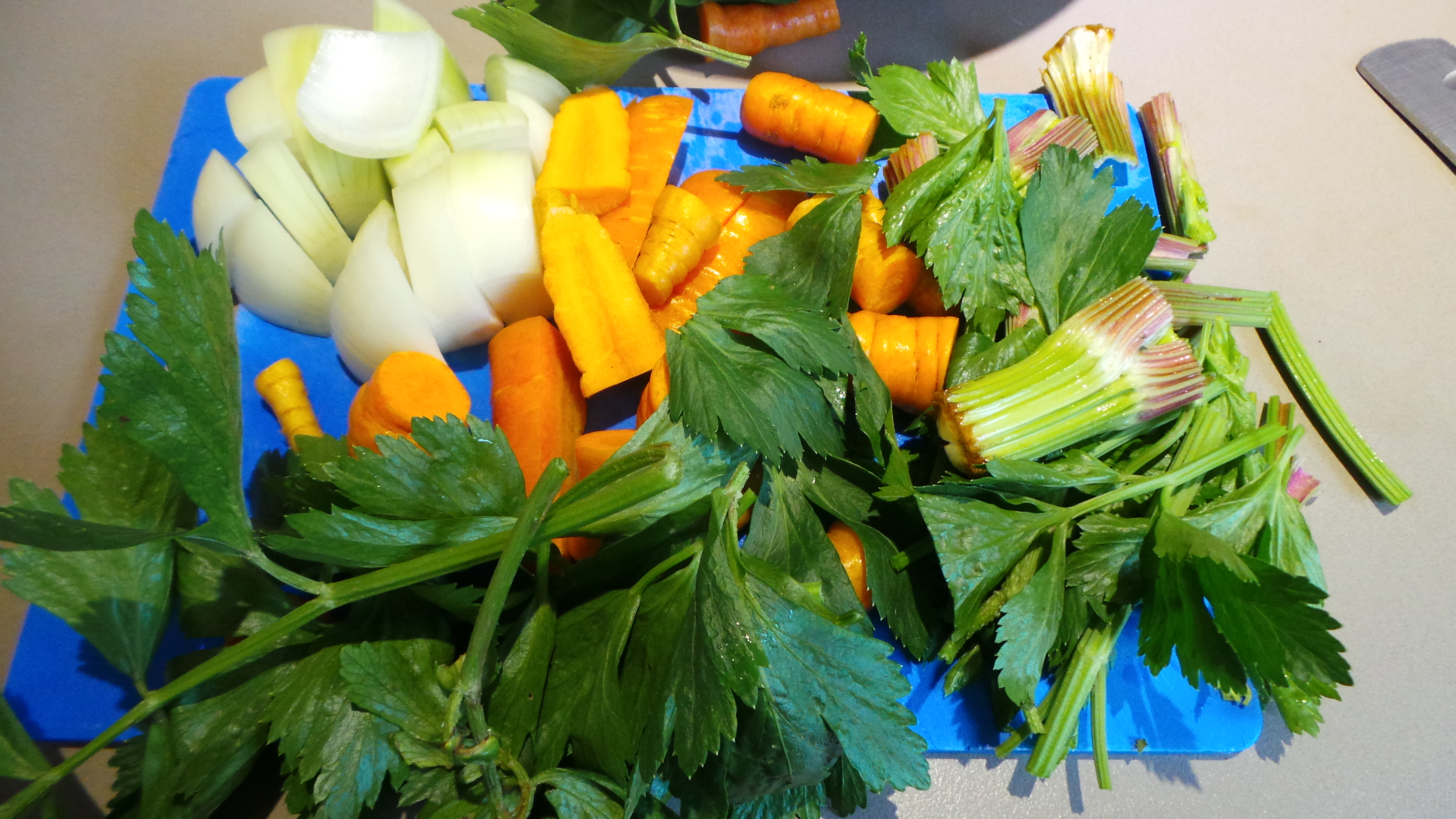
To the slow cooker add a roughly chopped onion, a couple of carrots and some celery. There is no need to add salt or any other seasonings. You want your stock to be as versatile as possible, add other flavours to the final dishes not here.

Roughly chopped vegetables

Roughly chopped vegetables

It honestly doesn’t matter how your vegetables look either. They’re all going to be thrown away at the end of the process — after every skerrick of flavour has been cooked out of them. Basically, you just want to be able to fit them in the pot with the chicken.

Cover the contents with water – you can boil the water first if you wish.

Add water to your stock pot

Add water to your stock pot

Turn the slow cooker on to low and then ignore it for 8 or so hours. Better yet, get this all done after dinner and leave it to cook overnight while you sleep. You’ll wake up to a delicious smelling house and a slow cooker full of something that looks like this…

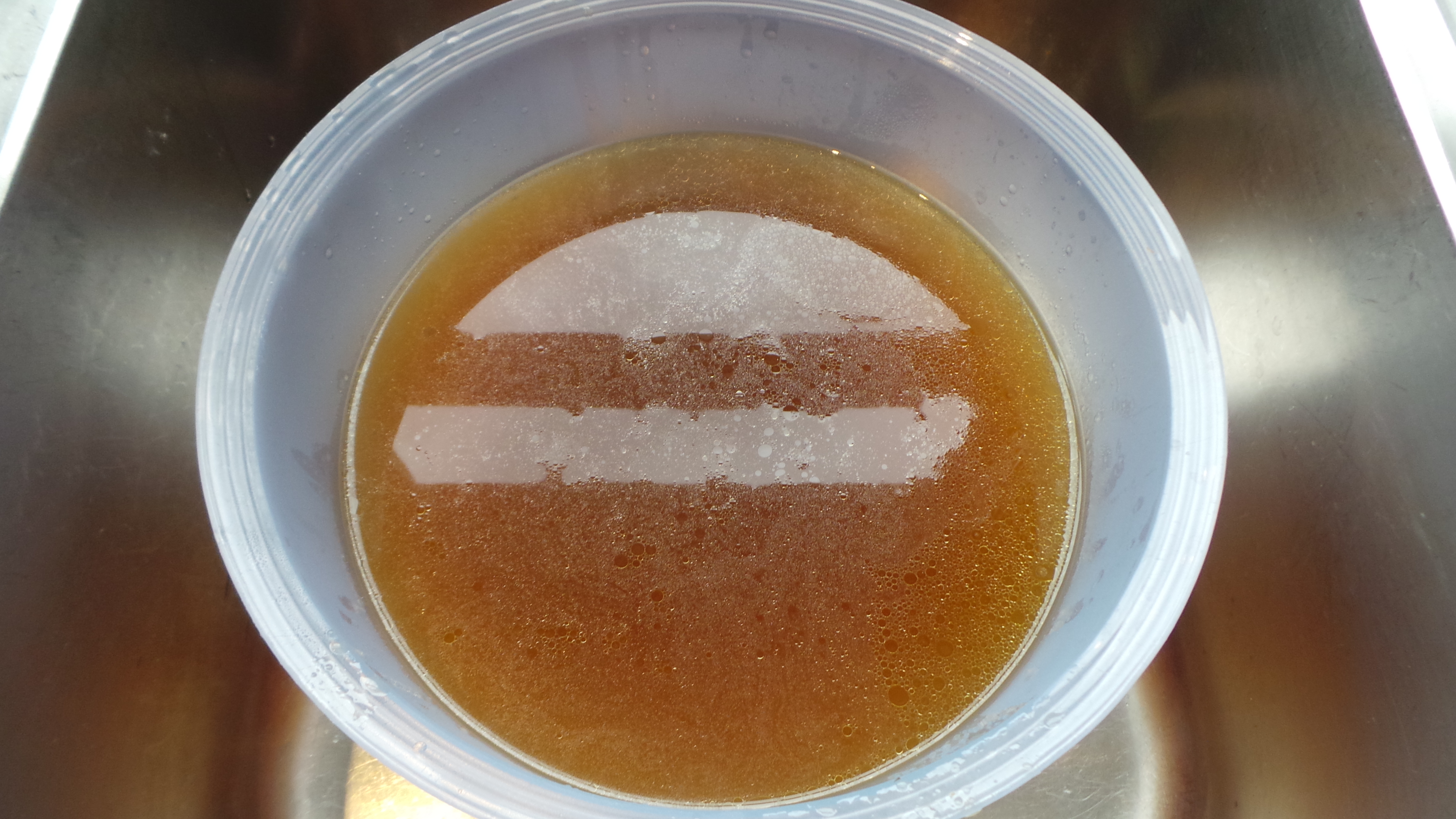
Cooked chicken stock

Cooked Chicken Stock

And doesn’t that look terribly unattractive? Don’t worry, it’s not the finished product.

Turn your slow cooker off, let the contents cool for a bit, and set a large sieve inside a large bowl. Line the sieve with some cheesecloth or a new kitchen wipe like this:

Line your sieve with a fresh cloth

Line your sieve with a fresh cloth

Then upend the contents of your slow cooker into it. It will look horrendous.

Strain the broth from the solids

Strain the broth from the solids

Walk away from the sink. Shower, dress, have a nice cup of something warm and caffeinated.

Leave it alone.

Then, after an hour or so, remove the sieve and discard the contents. Bin them, bury them, place them in your compost or Bokashi bin; you will no longer need them in your kitchen. What you will want is this, this liquid gold. <cue heavenly choir>

Pure chicken stock

Pure chicken stock

Don’t worry about the fine layer of fat you can see in the sheen on the surface. That is pure flavour and, when chilled, will give the stock a gelatinous texture.

Now, all you need to do is bottle it. Place it in some sterilised mason jars and freeze it as I do.

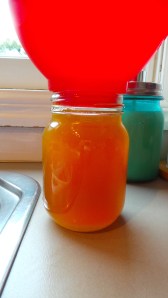
Mason jar of chicken stock

Mason jar of chicken stock

You could also place it into ziploc bags for freezing.

Alternatively, you can put it in a large saucepan and boil it until it is so reduced that you can freeze it in ice-cube trays as an über concentrate that you add water to when defrosted.

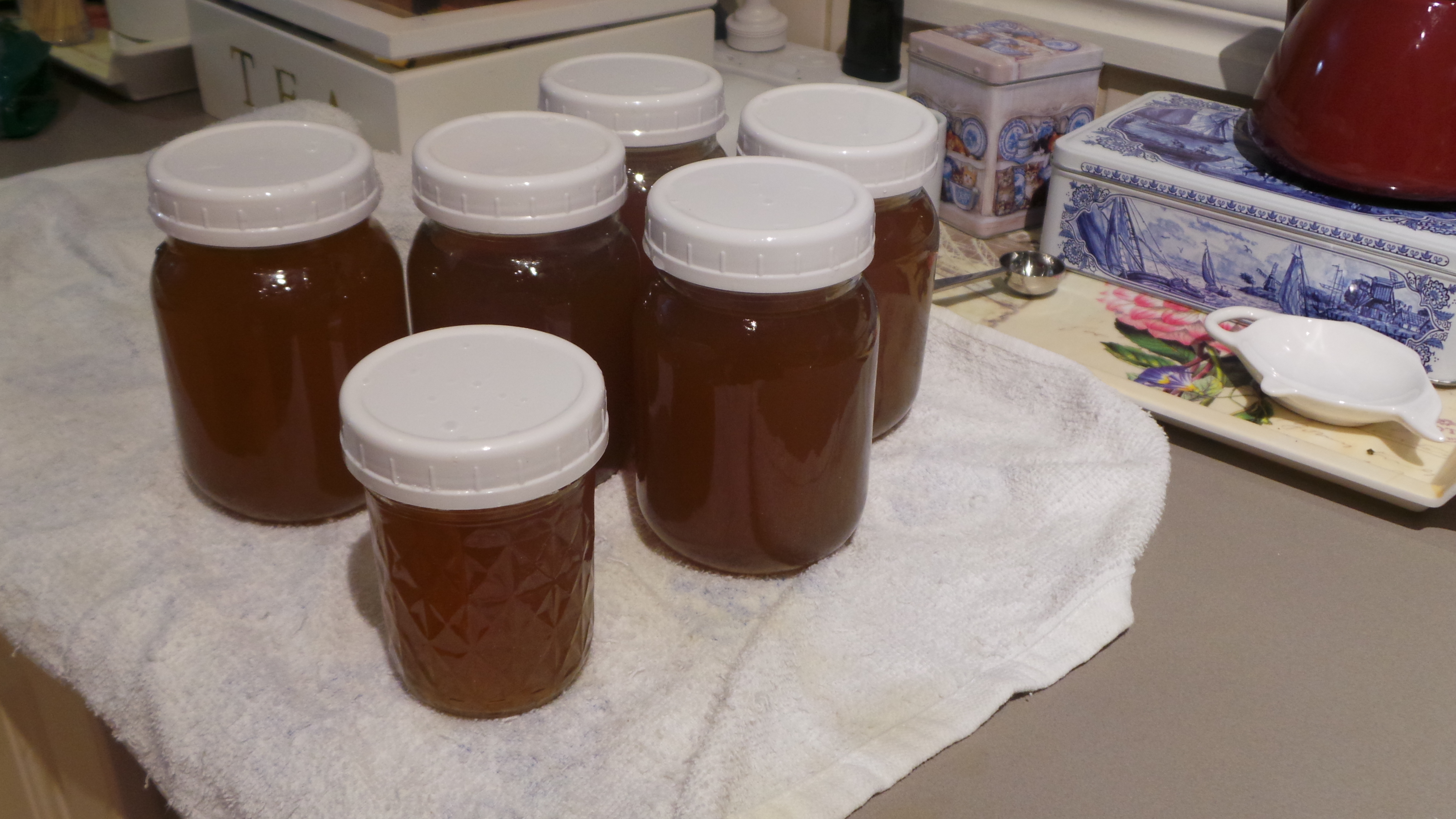
My 3 litre slow cooker made 2 ½ litres of stock. Isn’t it purdy?

A whole batch of chicken stock

A whole batch of chicken stock

Give it a shot, you’ll love the results. I promise. It will also make you feel all chef-y and virtuous (for not throwing food away) at the same time.

Let me know how you go.

*Side note:  Try going into an American supermarket and asking for a BBQ Chook. I dare you. If you happen to be an American reading this, it can be translated as ‘Rotisserie Chicken.”  You’re welcome.

Apple Crumble

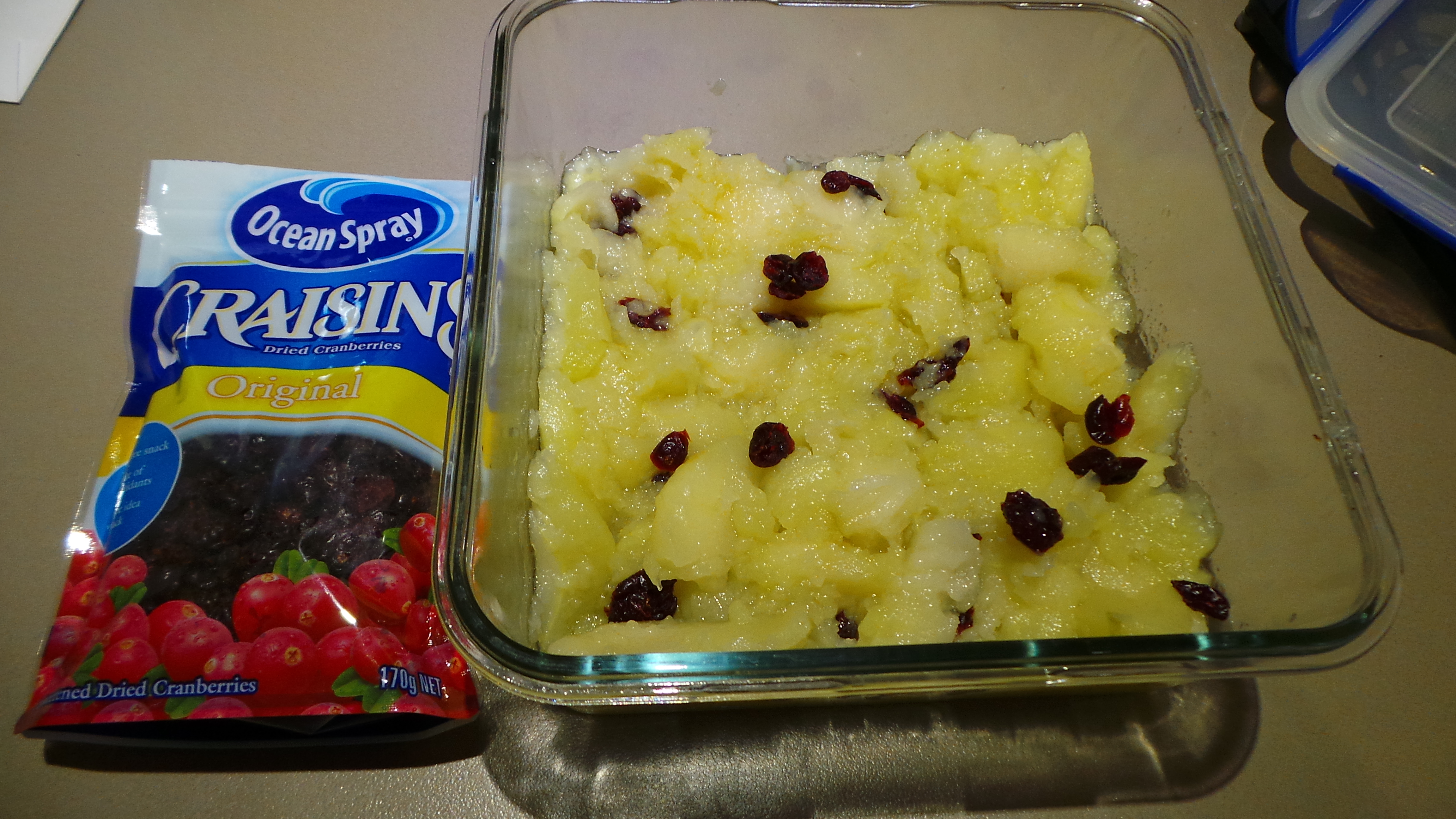
Scatter your apples with craisins for one variation

It’s cold here.

Technically, we’ve just hit the first day of Spring. It’s still cold though. And wet. And grey. And generally miserable.

A wet footpath

Gray Day

Weather like this demands something along the line of comfort food, and this pretty much ticks that box – along with the boxes for affordability, ease of preparation, wholesome ingredients and the ability to double as breakfast should it ever be necessary.

Let us pray that it is necessary…and often.

While I am all for foods that are prepared from scratch, I don’t think that this is one that has to be – in the strictest sense of the term. Because, sure, you could buy some apples and peel and cook them and then go on and make the crumble topping and bake it – and more power to you if you do.

However, I like to do one of these pretty much every week during the bleaker autumn/winter days and even don’t have the dedication to this that would require the peeling of so many apples. I don’t peel things unless it is absolutely necessary. Ever.

So, I use tinned pie apples. They’re readily available, rarely cost much more than the unpeeled ingredients and when the contents of the can are listed as ‘100% sliced apples’ then there is very little to complain about.

Pie Apple tin label saying it contains 100% apples

100% apples

Open a can, empty contents into baking dish, top with crumble, cook, serve.

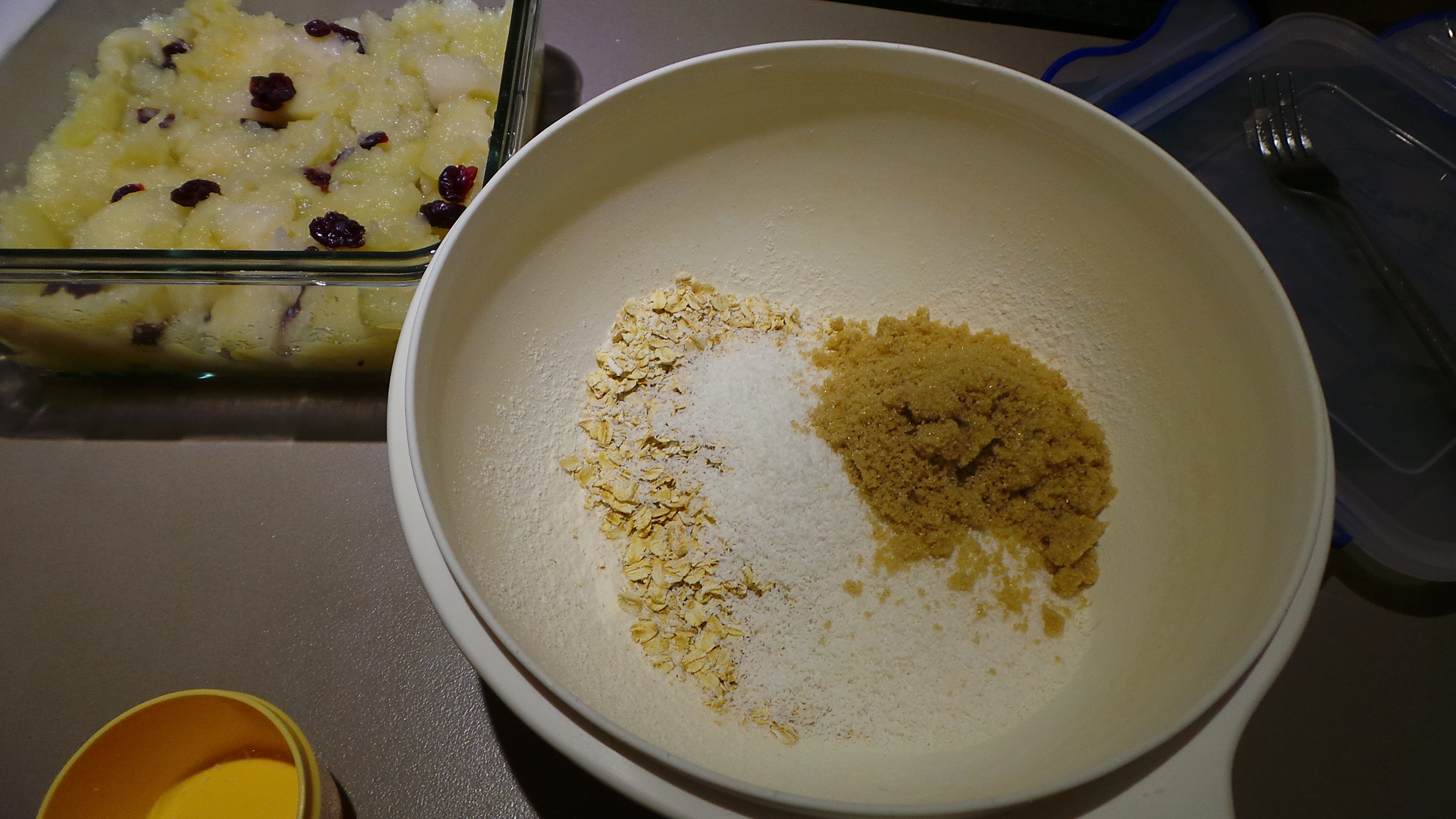
Mix all the dry ingredients in a large bowl

Mix all the dry ingredients in a large bowl

Fab.

However – and there had to be one of those, donchaknow – this is not a low sugar ingredient. Neither is it a low GI one. This dish will affect your blood glucose levels and possibly in ways you had never even considered. Go easy on the serving sizes; make it in a long, shallow dish so that the ratio of oat-filled topping to apple sub-strata is higher. Your insulin levels will be steadier and your children (and significant others) will be less likely to have that sugar high we all dread.

Serve it hot or cold with ice-cream or Greek yoghurt, try it with custard, eat it on its own….

Apple Crumble

  • Servings: 4-6
  • Difficulty: easy
  • Print

Ingredients:

1 x 800g tin Pie Apples

1 cup flour

125 g butter

½ cup rolled oats

½ cup coconut

2 tbsp brown sugar

1 tsp cinnamon

Method:

Heat oven to 180°C/ 375°F.

Place apples in a shallow glass baking dish.

Put all your dry ingredients in a large mixing bowl.

Melt butter in the microwave. Add to dry ingredients and mix through until well combined and crumbly.

Scatter over the top of the fruit and bake in the oven for 50 minutes.


Scatter your apples with craisins for one variation

Scatter your apples with craisins for one variation

Variations:

Try adding slivered almonds or chunks of Macadamia nuts to the crumble topping.

Try also, scattering dried fruit like sultanas or craisins among the apple, diced dried apricot can be an absolute hit used like this.

For a sweeter variation, add some dark choc chips/milk choc chips/caramel choc chips to the apple mixture or just scatter them over the top of it before adding the crumble mix.

I wouldn’t advise putting them in the crumble itself to avoid scorching them in the oven.

You can, of course just add chunks of whatever chocolate you prefer, it doesn’t have to be in chip form!

Eat slowly, with a small spoon for maximum savourousity*.

(*Actual word that I just made up.)


Anzac Biscuits

Anzac biscuits are pretty much a part of every Australian child’s culinary vocabulary. We’ve all had them and we’ve pretty much all made them.

Some are woeful, some are good and some are extraordinary. It really just depends on the cook and the preference of the muncher.

These biscuits are so-called because they were sent to the ANZACs in their Turkish trenches nearly a century ago. As such, they were needed to last during long storage on sea voyages and in less than optimal food storage conditions in the war zone.

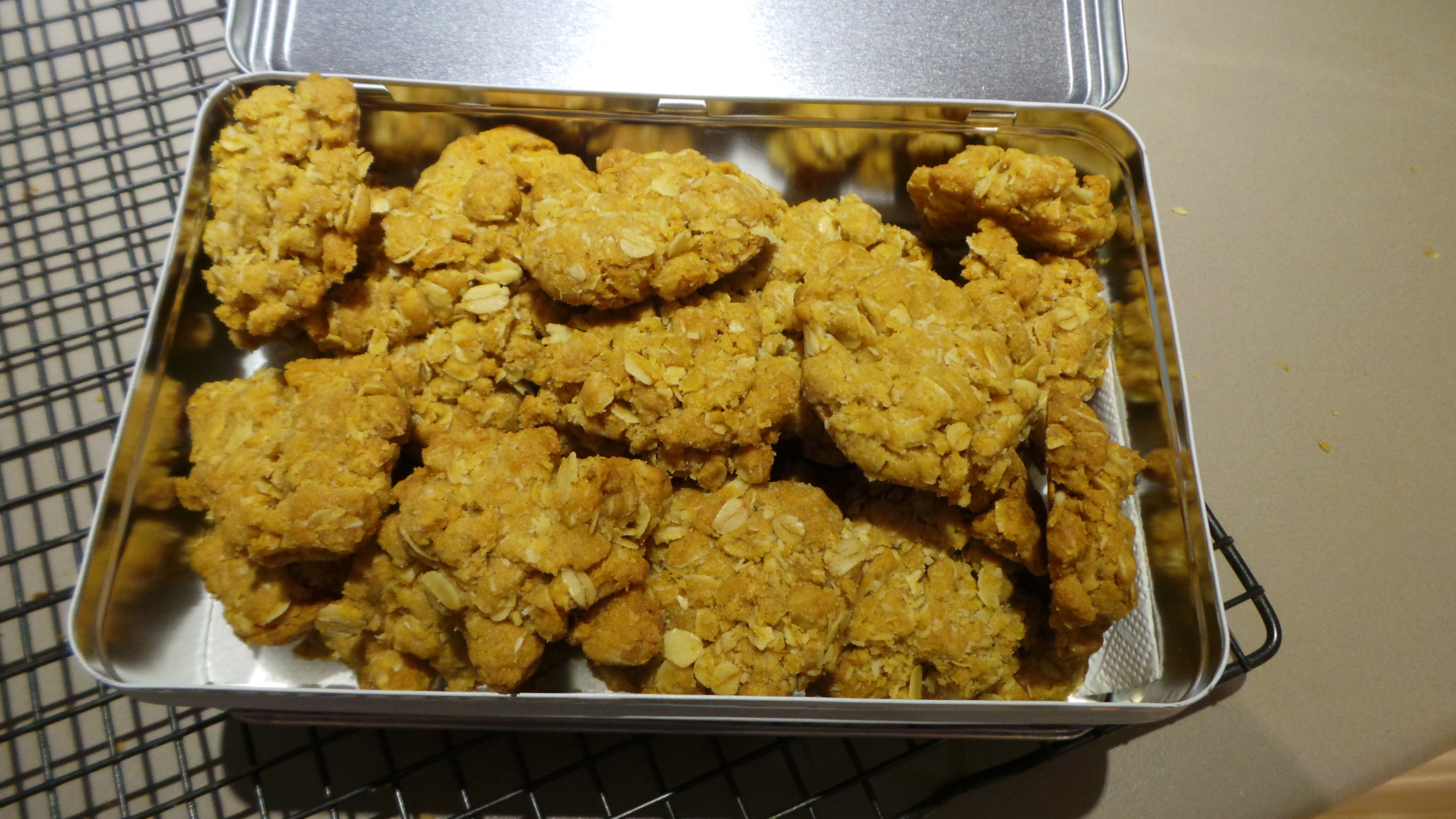
A tin full of freshly baked Anzac Biscuits

A treasure trove of Anzac Biscuits

This meant they were often rock hard. My brother famously christened my mother’s as “Bathroom Floor Biscuits” because he said they needed to be smashed on the tiles in order to eat them!

(He wasn’t wrong.)

Thankfully things have changed. We no longer bake the life out of them for a start.

This is the recipe that I use for Anzac biscuits, it came originally from The Australian Womens Weekly’s The Basic Cookbook and I’ve been using it for over 20 years. It works.

Make them with your kids today.

Just remember that these are biscuits and not cookies. They will be crunchy all the way through, and not chewy in the middle.

If you don’t have, or can’t get, Golden Syrup (you poor, poor thing!) you can substitute honey or corn syrup at a pinch…

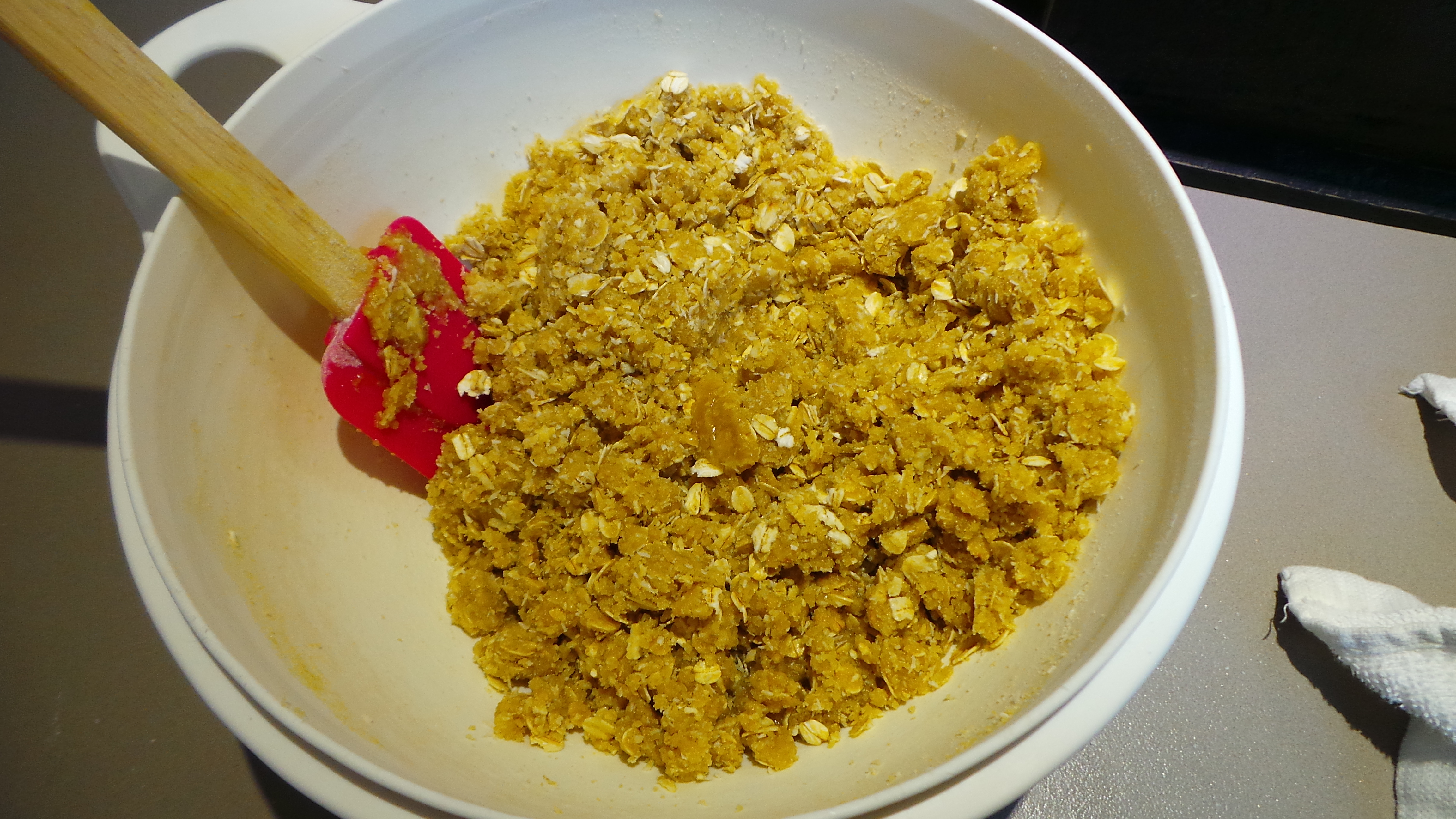
A bowl of Anzac Biscuit mix before it's divided into biscuits

Anzac Biscuits in the bowl

Anzac Biscuits

Ingredients:

1 cup rolled oats (not minute oats)

1 cup plain flour

1 cup brown sugar, firmly packed

½ cup desiccated/shredded coconut

125 g butter

2 tablespoons golden syrup

1 tablespoon water

½ teaspoon bicarbonate of soda.

Method:

Heat oven to 160°C/325°F (Moderately slow.)

Lightly grease or line several baking trays.

Combine oats, sifted flour and sugar together in a large bowl.

In a small saucepan, combine butter, golden syrup and water and stir over low heat until butter is melted. (This step may be done in a microwave oven.)

Stir in soda.

Add mixture to dry ingredients and stir until combined.

Place rounded teaspoonfuls of mixture onto trays 5 cm or two inches apart. These biscuits will spread!

Bake for about 20 mins or until biscuits feel slightly firm.

Cool on trays.

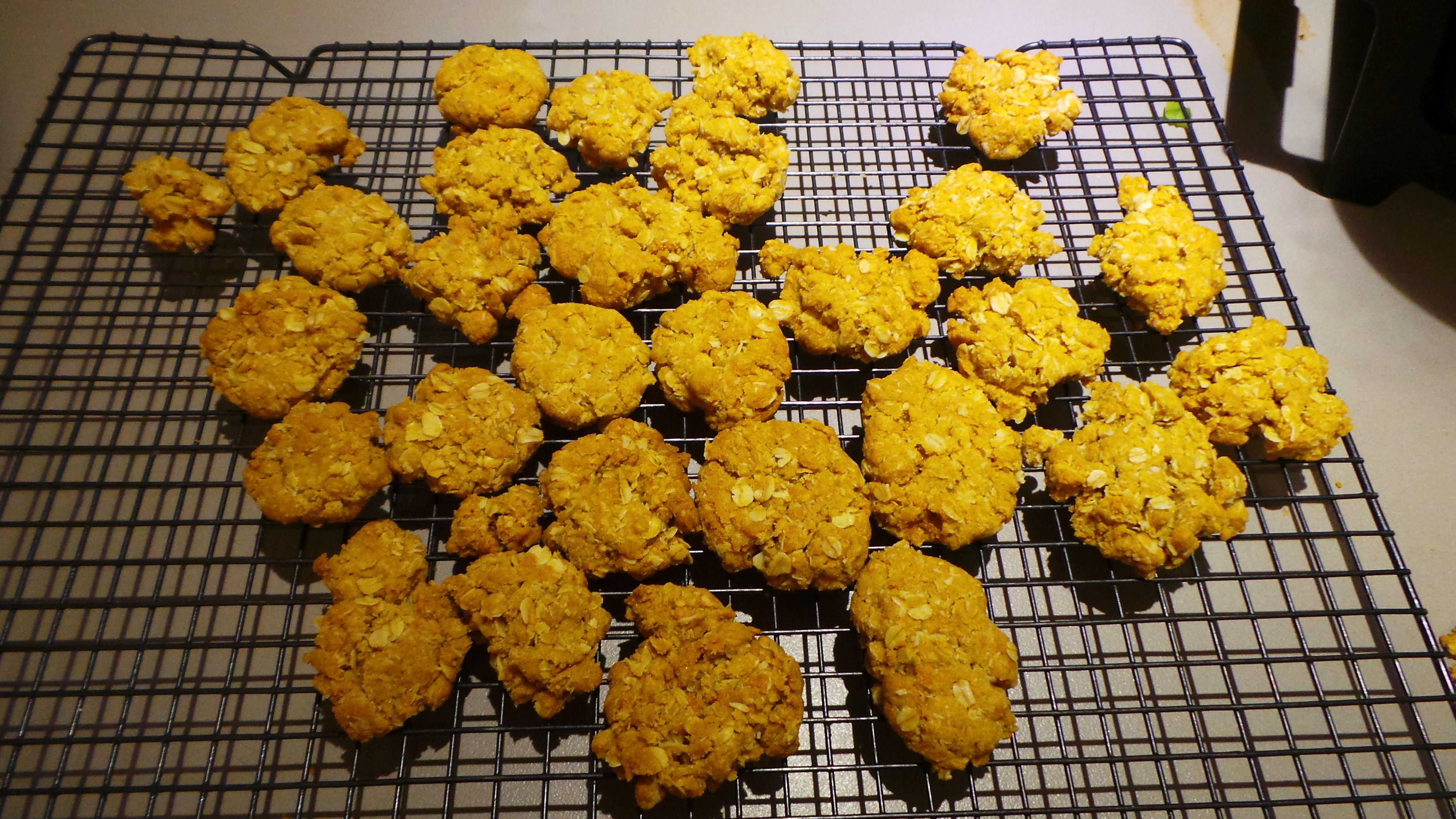
Anzac Biscuits cooling on a rack after baking

Try not to eat them all at once

Also, don’t panic if your biscuits lose bits as you transfer them from the trays. Save all these little crumbs of oaty, golden-syrupy goodness and store in an air tight container. They are excellent scattered over plain Greek yoghurt or ice-cream. Trust me on this.

Some years ago Heidi Swanson did a piece on Anzac “Cookies” on her fabulous site 101 Cookbooks, where she talked about them being a type of flapjack. Unfortunately, the post appears to have been reworked and this info has gone. However, she has posted a variation using the addition of orange zest and orange blossom water which looks almost worth forgiving her for calling them cookies…

Let me know how you go with this fine old Aussie tradition, or if your family does a different version. My grandmother always added ground ginger to hers…

Enjoy!

IMG_0172.JPG